
By
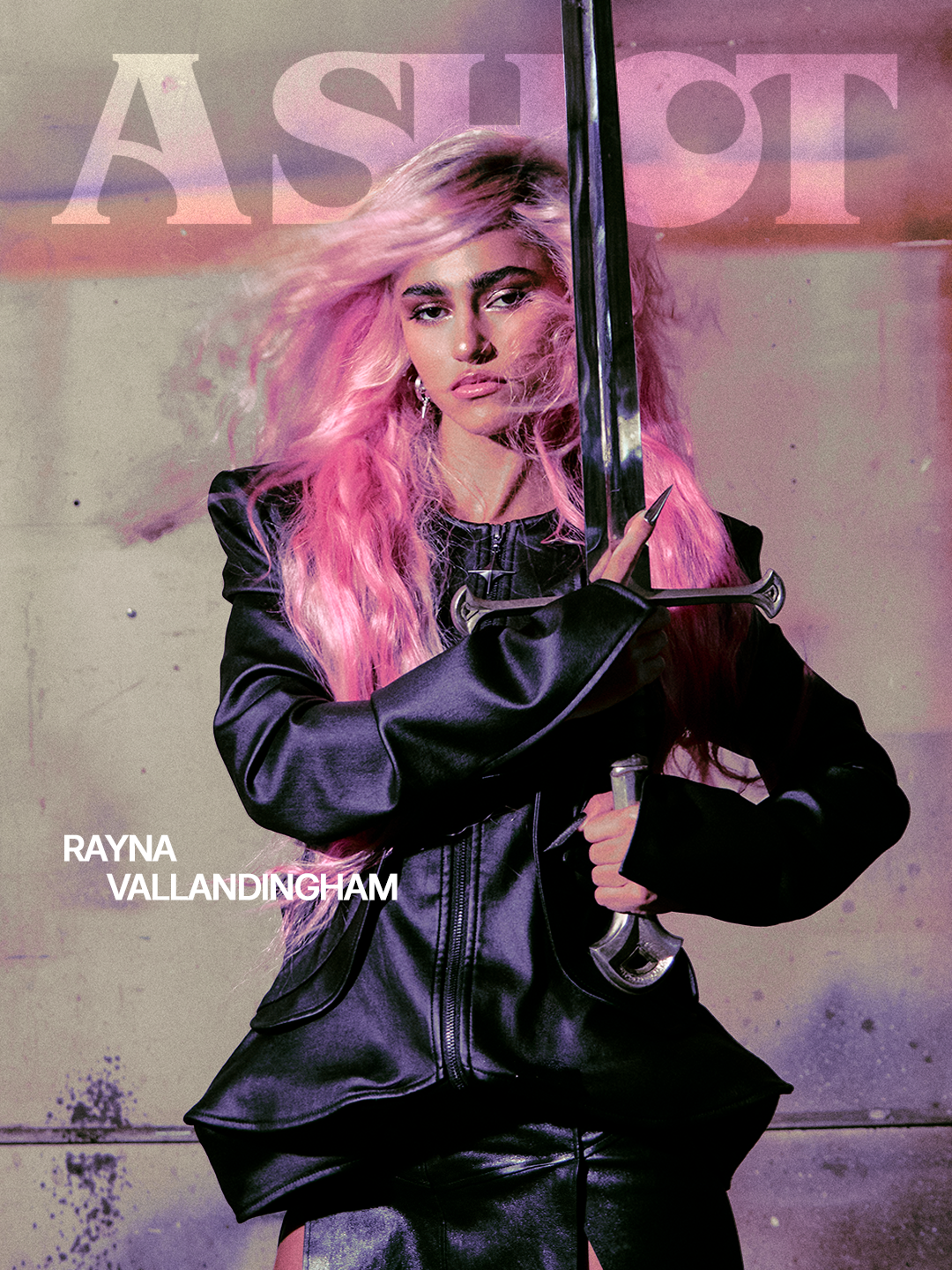
There are rules to fighting. You train, you step into the ring, and somebody gives you a score. For most of Rayna Vallandingham’s childhood, that structure was second nature.
A 13-time world champion and fourth-degree black belt, Vallandingham has been practicing martial arts since she was two and a half. At six, acting introduced her to a world governed by something far less measurable. More recently, her martial arts background has carried over onto the screen, from playing Zara Malik in the final season of Cobra Kai to a role in Citadel and now, playing Juli in the upcoming Street Fighter.
“In martial arts, your competition takes place in the ring,” Vallandingham tells A Shot. “You train relentlessly outside of it. But when it’s go time, you immediately get judged and scored on a numeric system.”
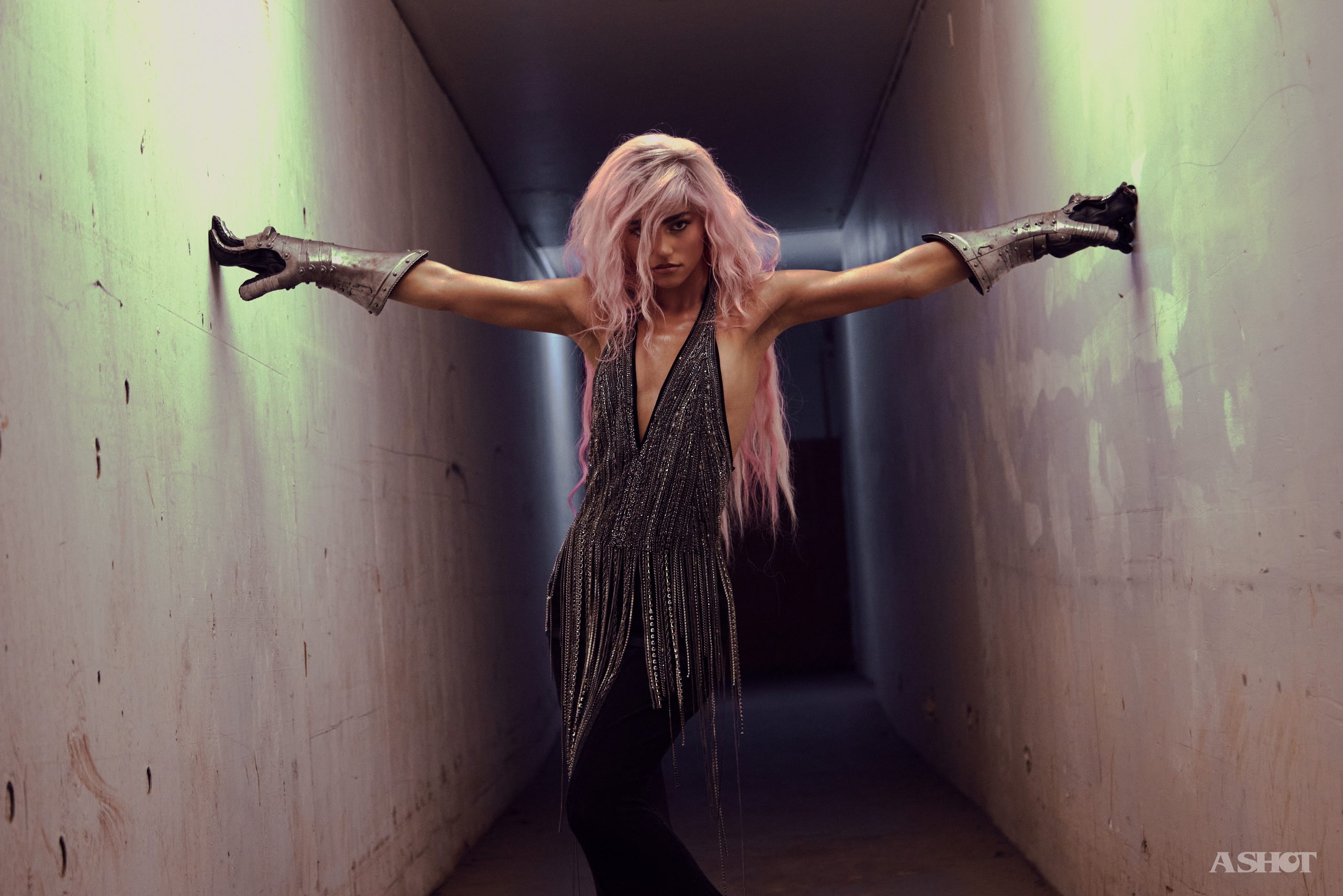
Dress @sarawongofficial
Gauntlets @balenciaga
Acting offered none of that certainty. What it did offer was something she hadn’t known she was looking for. “I think that was a set where I just absolutely fell in love with acting,” she says. “I was really scared, but when all of that melts away and they call action, you just get that sort of indescribable feeling.”
At six years old, Vallandingham couldn’t necessarily explain what that feeling was. She only knew she wanted it again.
“That was the moment that I was like, this is what I want to do for the rest of my life.”
Nearly two decades later, the ring hasn’t disappeared from her life. If anything, Vallandingham has spent the years since figuring out how to bring it with her onto a film set. Today, she finds herself pursuing a different kind of fight: becoming the action star she spent her childhood searching for on screen.
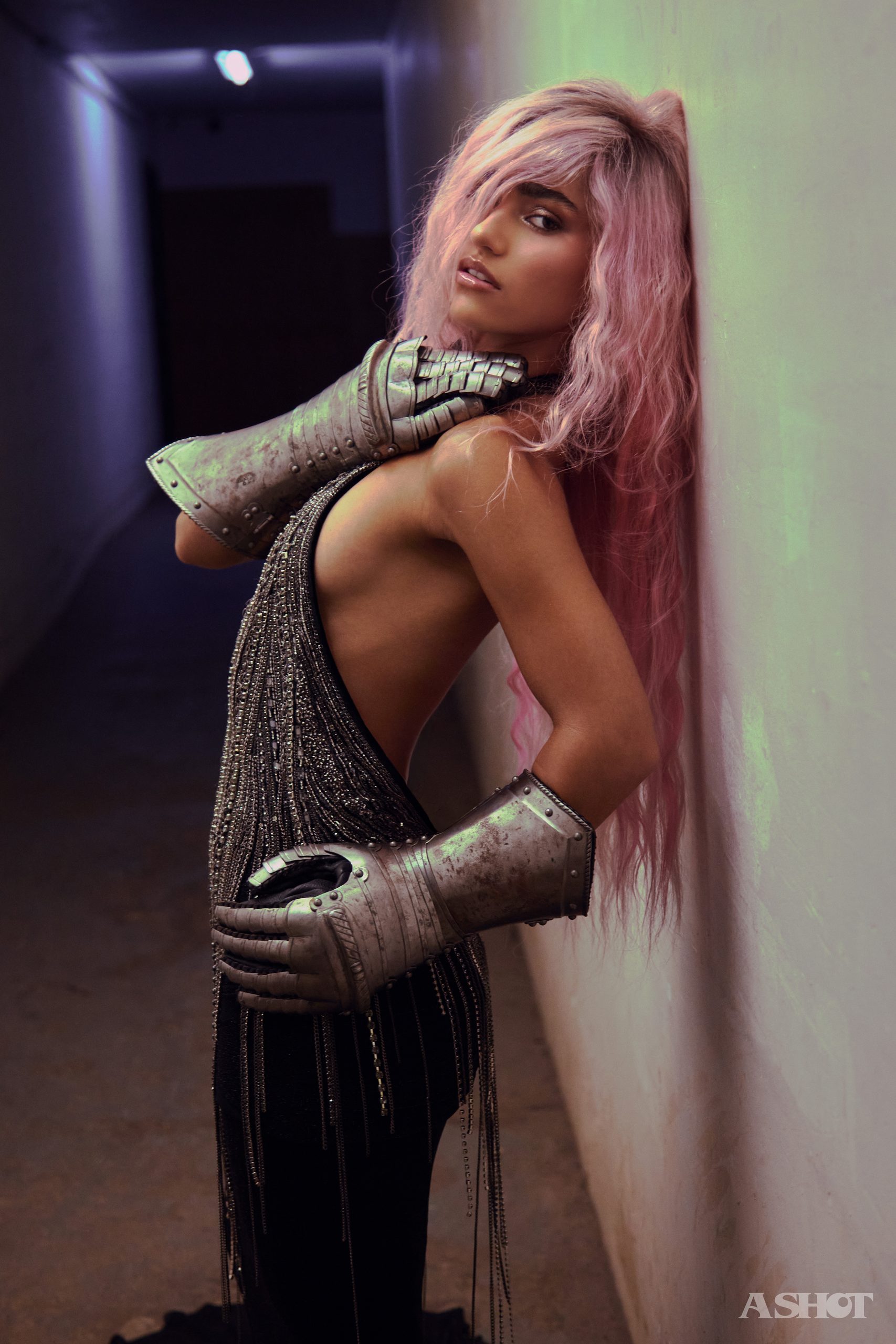
Dress @sarawongofficial
Gauntlets @balenciaga
The obsession hastily became a family affair. Vallandingham’s father had introduced her to Kill Bill around the same age, planting an early image of what martial arts could look like when translated to the screen. “I was like, ‘Oh my God, I want to be here so bad,’” she gushes.
Her mother helped turn that fascination into something tangible. Growing up in San Diego, Vallandingham grew up shuttling between school, martial arts training and auditions, with her mother regularly taking her out of class and driving her to opportunities until she was around 16. “She made a lot of sacrifices and was so, so supportive of me,” Vallandingham says. “That’s my girl. That’s my girl for life.”
Those years also began collapsing the distance between the fighter Vallandingham already was and the performer she was becoming. The boundaries between martial arts, acting and, later, content creation have only grown more porous, each feeding naturally into the next. “I’m not really into the whole side of, ‘This is my brand and this is who I am,’ and I’m pushing and I’m forcing it,” she says. “I just want people to feel my passion through the screen.”
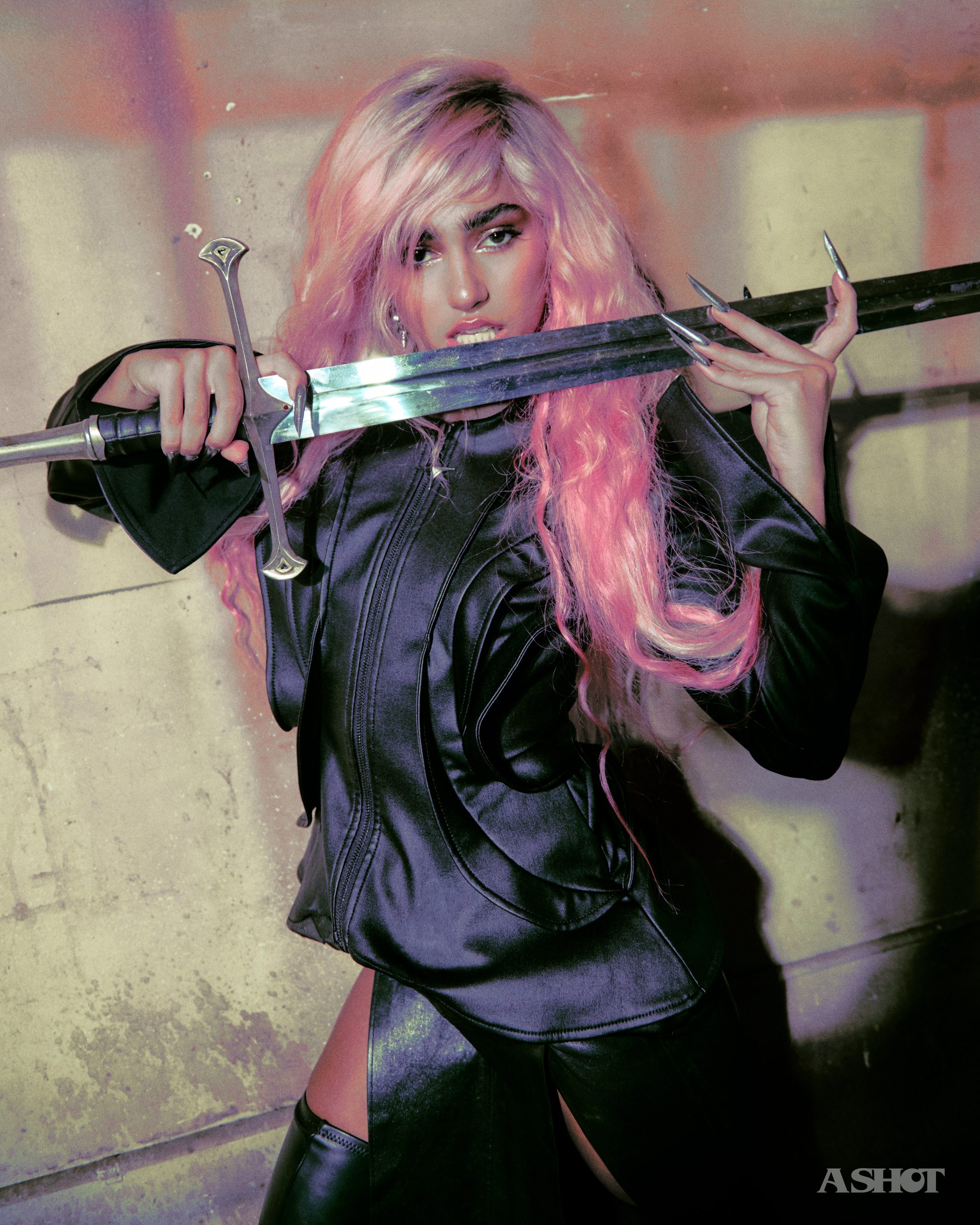
Coat @annakikiofficial
Skirt @heiraleatherwear
Shoes @gcdswear
Vallandingham’s career now sits at the intersection of athlete, actor and content creator, though she has little interest in engineering those identities into a tidy personal brand. To her, their convergence feels inevitable: martial arts and performance have occupied the same space in her life since childhood, while the audience she has built online just offers another place for that relationship to exist. “I’m not really into the whole side of, ‘This is my brand and this is who I am,’ and I’m pushing and I’m forcing it,” she says. “I just want people to feel my passion through the screen.”
For someone whose childhood was structured around competition, Vallandingham speaks about championships with surprising distance. Competitive martial arts, she says, feels almost like a “past life” now. The trophies remain, as does the discipline that produced them, but somewhere along the way, winning stopped being the destination. “I want to be an action star,” she says plainly.
The ambition becomes considerably more specific from there. Vallandingham tells A Shot she wants to become “the first black-belt female martial artist who is able to do all of her own fight choreography on the big screen and mainstream media.” It is the sort of aspiration she knows can sound outsized when spoken aloud, but one that has become progressively more tangible as each new role brings the imagined career closer to the one she is actually living.
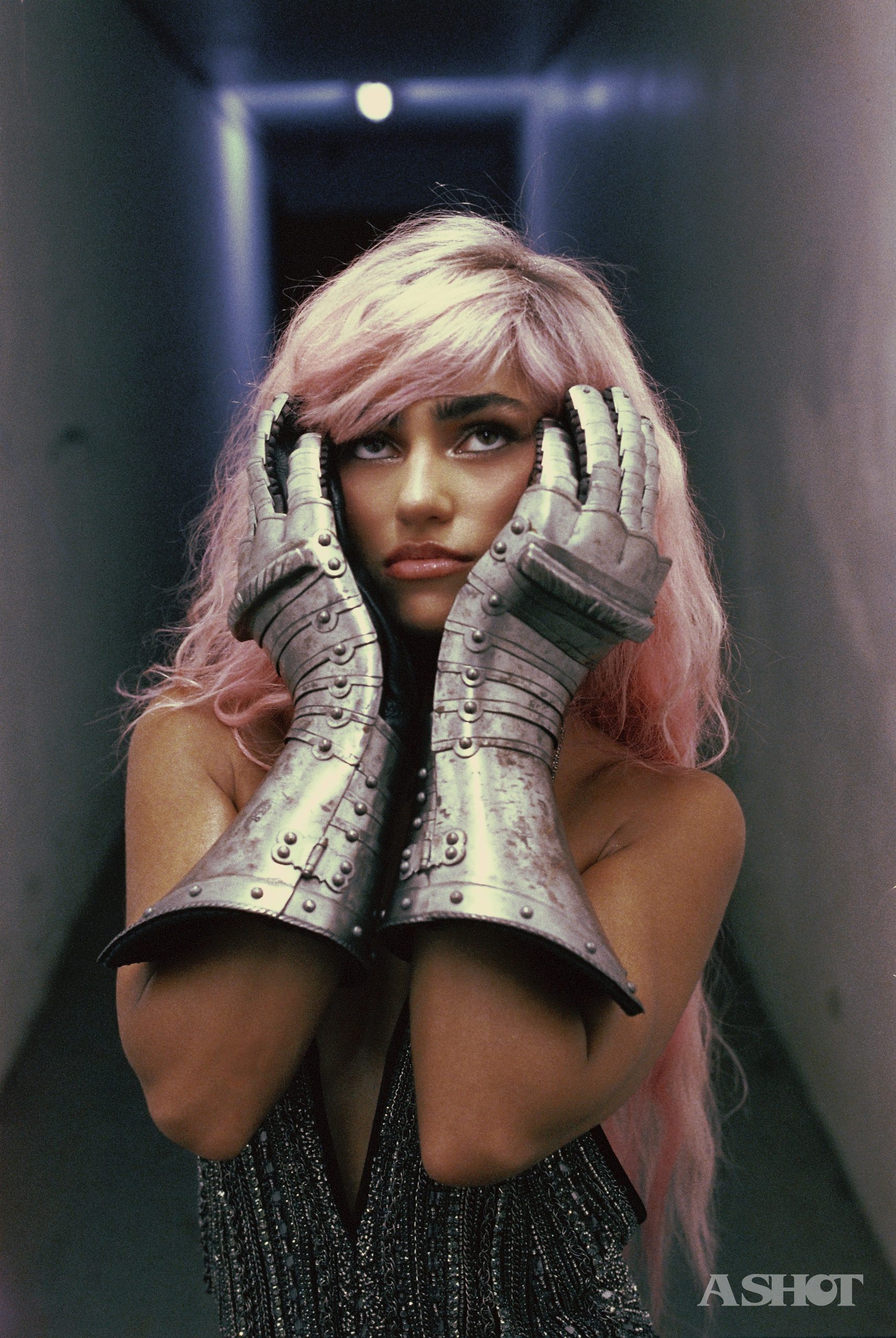
Dress @sarawongofficial
Gauntlets @balenciaga
Her North Star, as she calls him, is Bruce Lee. Not just for the films he made, but for the possibility they represented: that mastery of martial arts could become its own cinematic language, and that physical ability could carry character, philosophy, story, and spectacle. Vallandingham wants to build something similarly expansive for herself.
Fame, at least in the way she describes that future, feels secondary to impact. She wants someone watching her fight on screen to experience the same provocation she once found in the action stars she grew up with: the sudden suspicion that the limits of their own body might be further away than they thought.
“I want people to see my art and feel inspired to explore their own potential and capabilities.”
Bruce Lee had already done exactly that for her. Vallandingham encountered his films around the same age she discovered Kill Bill, but the recognition was unusually personal. Even as a young martial artist, speed had become part of her physical vocabulary: fast-twitch movement, rapid kicks delivered at different levels, the kind of explosive precision she would eventually build her competitive style around. “I saw him moving and kicking really fast, and I was like, ‘Oh my God, I do that. I love doing that,’” she remembers.
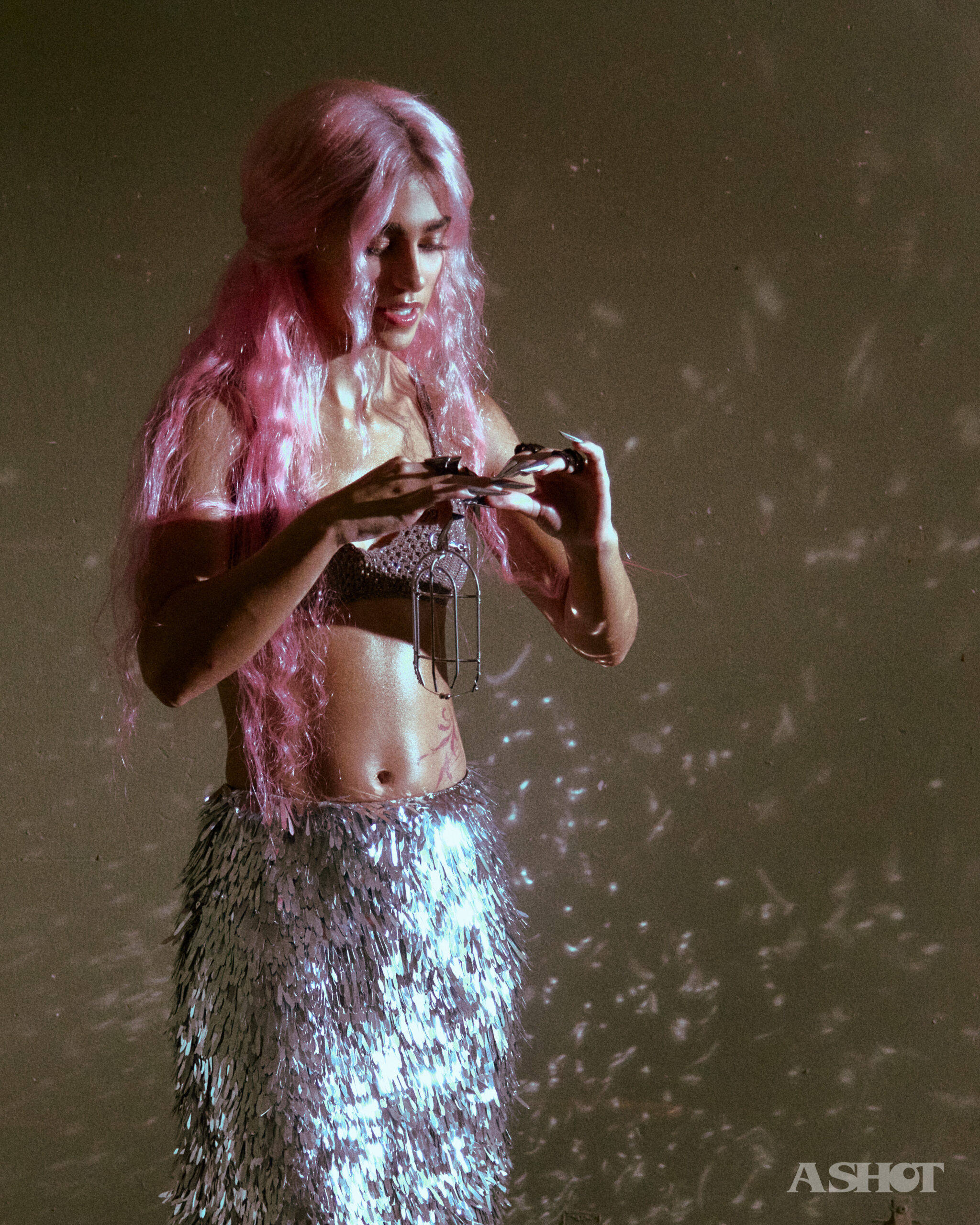
Bralette @shop_redemption
Skirt @annakikiofficial
Jewelry @rareromance
What stayed with her was the recognition embedded in that moment. Something she understood through her own body existed on a movie screen, magnified into the language of an action star. Lee offered a blueprint for what martial arts could become beyond competition, and years later, Vallandingham still returns to his films whenever her own trajectory feels uncertain.
“Whenever I feel lost in my career, I go back and watch Bruce Lee movies.”
There is a neat symmetry to Vallandingham now wanting to occupy that position herself. The child who once searched the screen for a version of what she could already do is trying to become that point of recognition for somebody else.
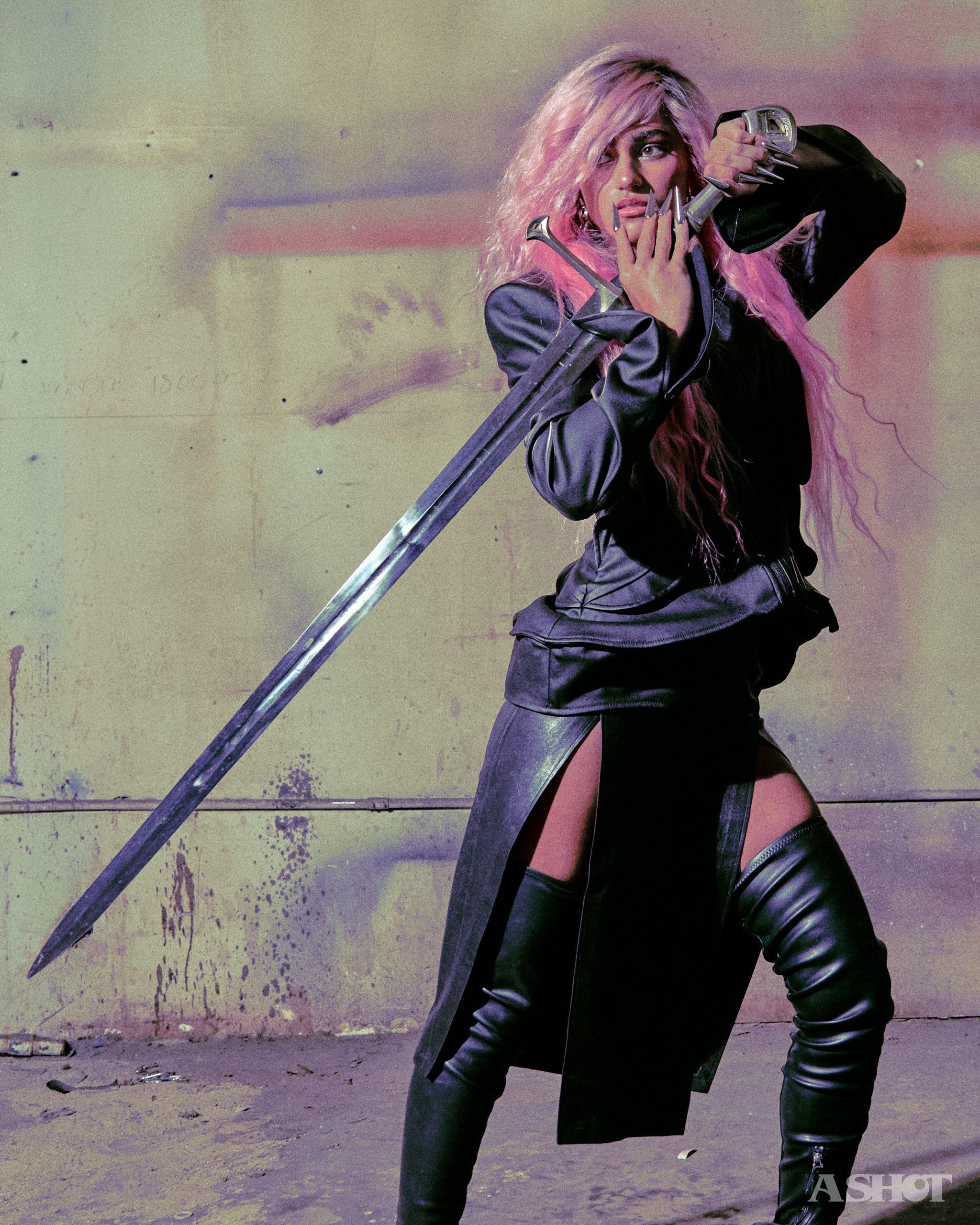
Coat @annakikiofficial
Skirt @heiraleatherwear
Shoes @gcdswear
For all the physical confidence martial arts has given her, Vallandingham has little interest in performing fearlessness. At 5’1”, she has spent much of her life training against people considerably larger than herself. As a child, that could mean being a ten-year-old girl facing a fourteen-year-old boy; adulthood has simply changed the proportions of the opponent. “That has always intimidated me,” she admits.
Her response to fear is surprisingly pragmatic. Size might belong to the person standing opposite her, but speed and agility can belong to her. She thinks in terms of leverage: getting in quickly, getting out faster, identifying the advantage available to her instead of pretending the imbalance does not exist. “I’m scared shit of it,” she confesses.
“But when I do succeed, it’s the most exhilarating feeling.”
Fear, then, is not something Vallandingham has trained out of herself. If anything, martial arts seem to have taught her how to remain functional in its presence.
That instinct does not disappear once Vallandingham leaves the mat. On a night out, she is less likely to be the oblivious friend than the one inaudibly surveying the room, particularly when someone approaches one of her friends. “There’s a designated driver. I’m like the designated fighter,” she jokes.
It is funny because she means it. When it gets dark and men are around, Vallandingham says her head is “on a swivel,” instinctively assessing who is nearby and whether anyone she is with might need protecting. Martial arts, after more than two decades, seems to have migrated beyond something she practices into something closer to reflex. “I’m definitely the protector of the friend group,” she says. That vigilance also reveals something about the way Vallandingham understands fighting. For all the spectacle attached to what she can do, its most ordinary expression in her life is protective.
The distinction between fighting competitively and fighting for a camera is one Vallandingham understands intimately. In competition, the body reacts before there is time to intellectualise the decision: an opening appears and you take it. Choreography necessitates almost the inverse. Every movement is contemplated, rehearsed and made to communicate something beyond physical ability.
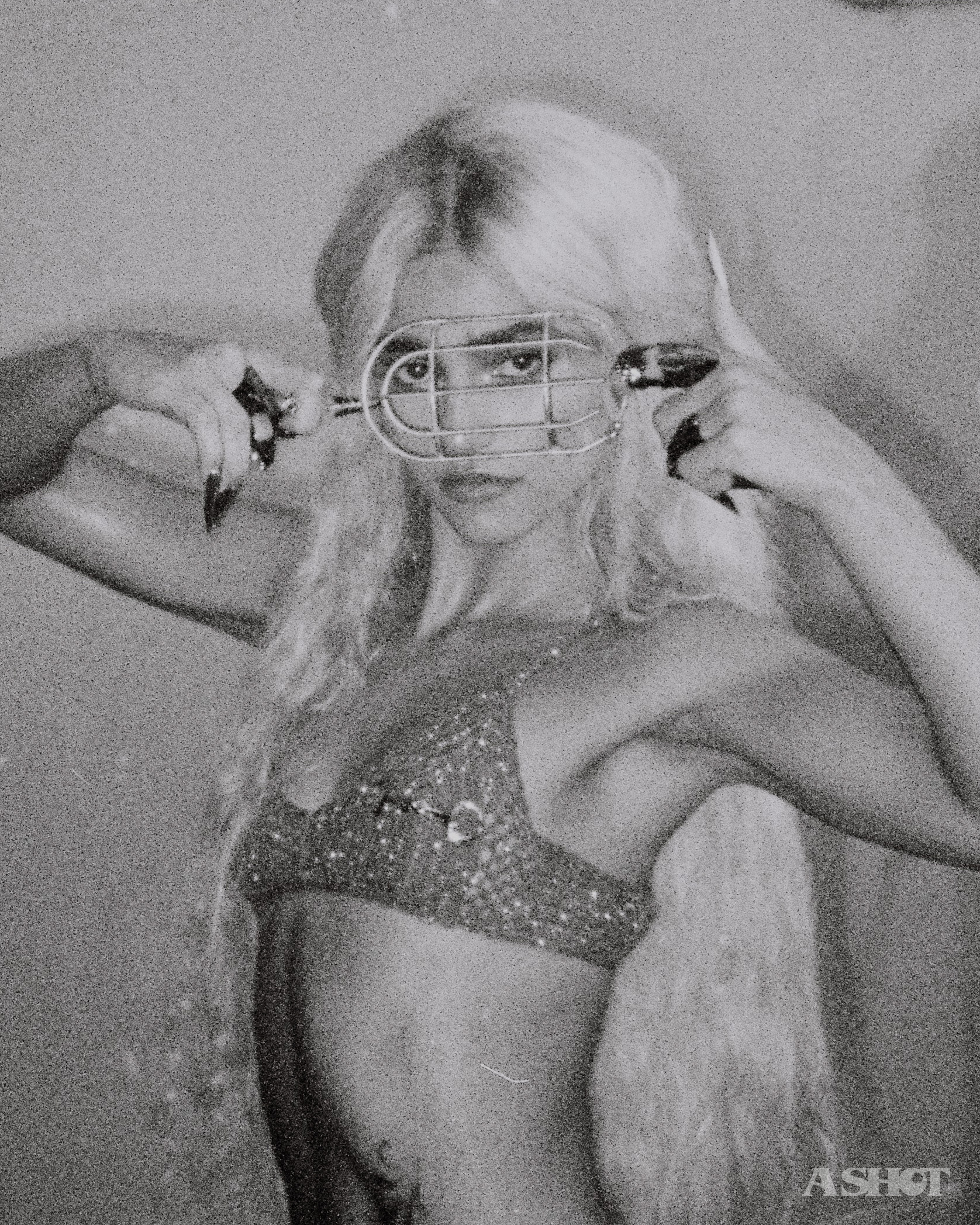
Bralette @shop_redemption
Skirt @annakikiofficial
Jewelry @rareromance
Gradually, Vallandingham suspects this is where her real fascination lies. She can spend weeks with a stunt team constructing a fight around the psychology of a character, asking not how she would throw a punch or evade one, but how the person she is playing would. Fighting becomes another mode of characterisation, with stance, rhythm and aggression carrying as much narrative information as dialogue.
Yet when the choreography is set and the cameras are nearly ready, the competitor resurfaces. Vallandingham puts in her AirPods, starts moving and asks the crew to give her a ten-minute warning before she is needed. It is a version of the ritual she once used before stepping into competition, enough to summon the physical intensity the scene requires. “I have to get myself into that fighter mode,” the actress says. The athlete, then, has hardly been left behind.
What plays through those AirPods depends entirely on who Vallandingham is about to become. On Cobra Kai, it was pop and rap. Citadel called for something more severe: instrumental music, intense violin, even Bach. Street Fighter carried some of that same intensity, with ’80s and ’90s rock folded into the mix.
The selection is yet another exercise in inhabiting the character. Her pre-fight question is wonderfully simple: what would this person listen to before going to beat someone up? It is a small ritual, but a revealing one. Even in the moments designed to summon her competitive instincts, Vallandingham is thinking like an actor.
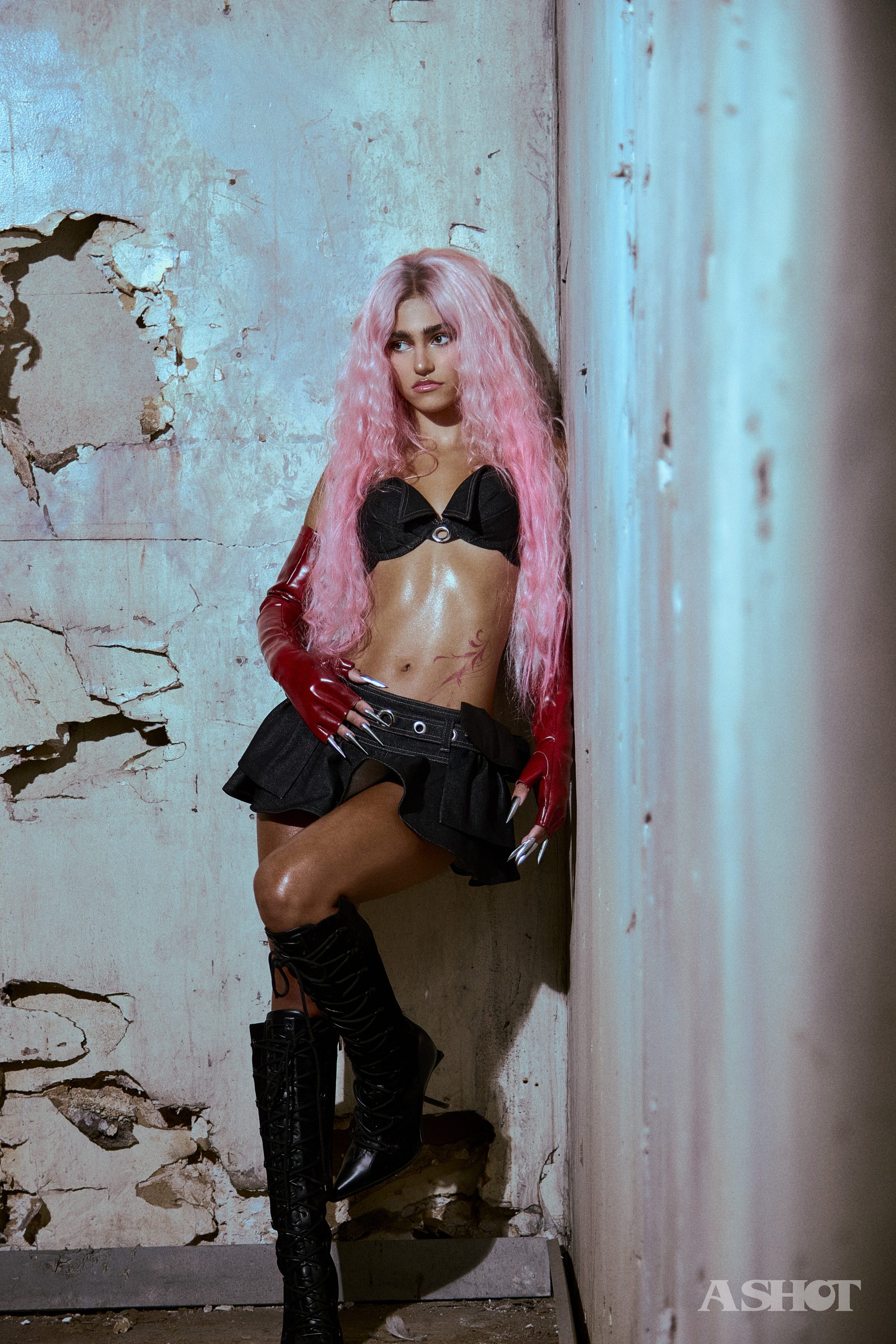
Set @fronzel.folio
Gloves @ritual_fashion
Shoes @damayaofficial_
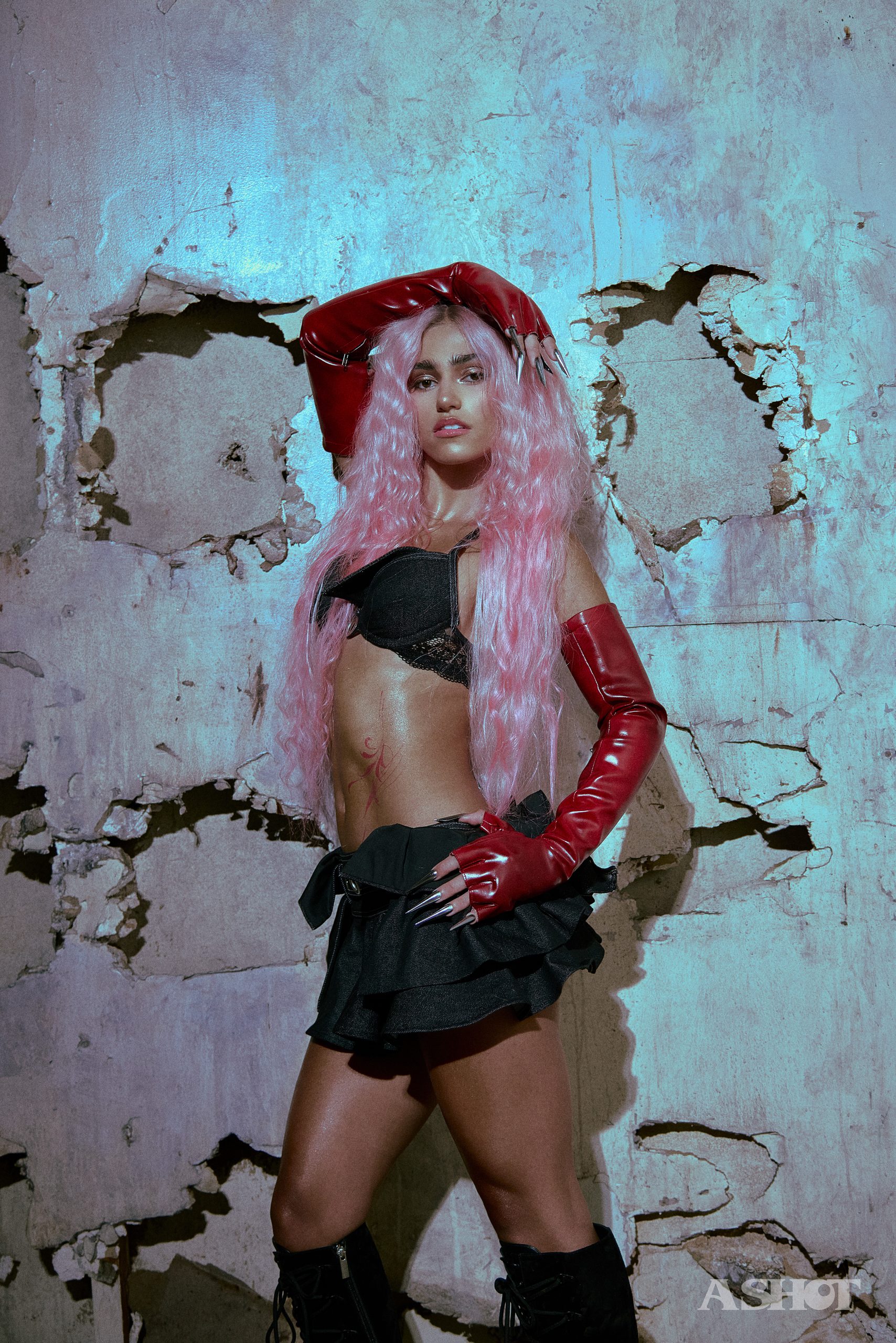
Set @fronzel.folio
Gloves @ritual_fashion
Shoes @damayaofficial_
For all the ways martial arts taught Vallandingham to use her body, it also taught her what to conceal. Strength meant composure, especially in competition, where tears could be dealt with behind a bathroom door before returning to fight. “It was always, ‘Don’t show emotion. You’re strong,’” she recalls.
“If I needed to cry, I would go to the bathroom, cry, come back and fight.”
The discipline served her as a competitor, but it sat uneasily against her temperament. Vallandingham describes herself as wildly emotional; she loves comedy, vulnerability and the freedom of being expressive. The qualities she had learned to suppress in one arena became essential currency in another.
“With acting, vulnerability isn’t shameful,” Vallandingham reveals. She can draw on the physical discipline that has governed her life since toddlerhood without surrendering the emotional range she once learned to compartmentalise. Fighting and feeling are finally permitted to seize the same performance.
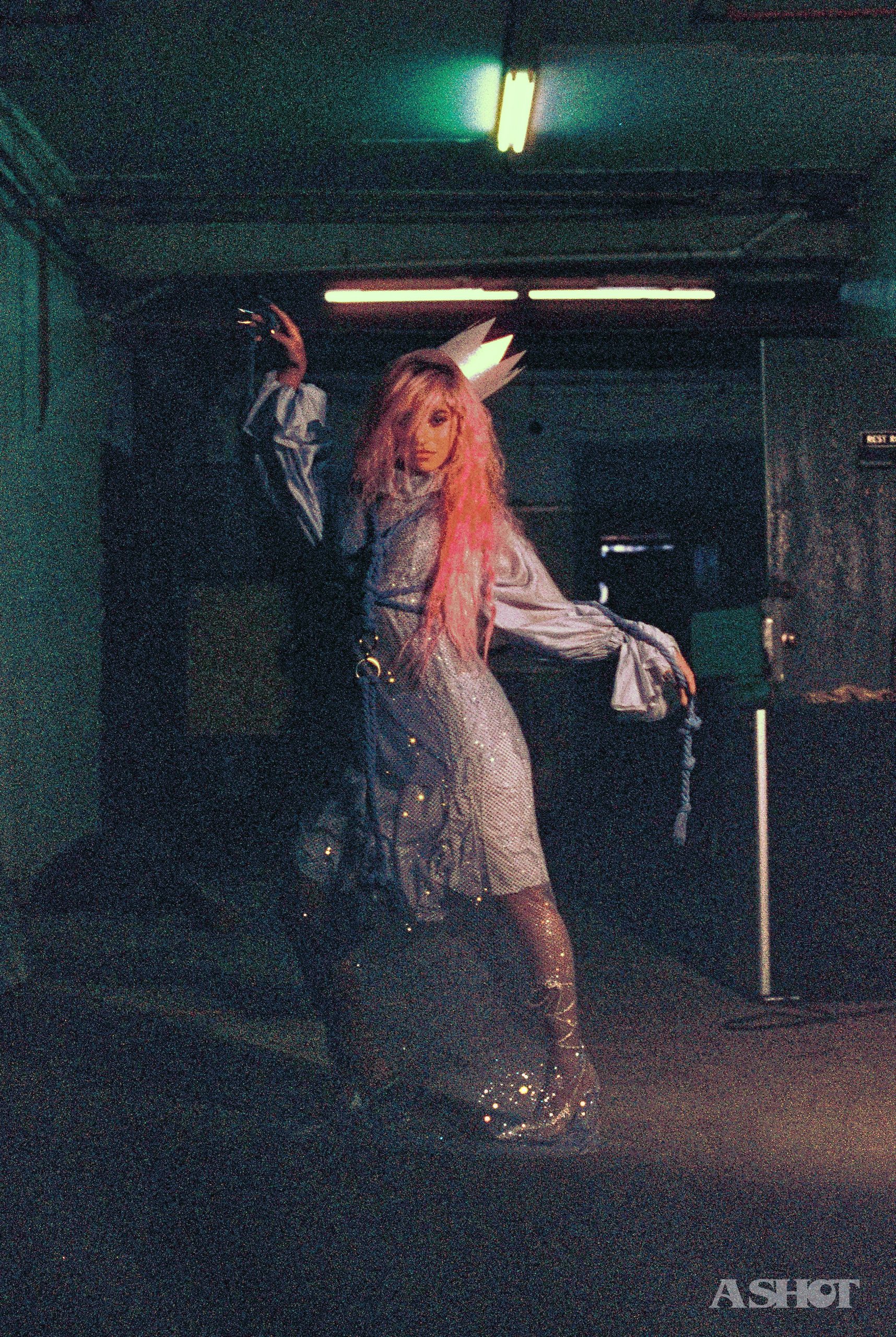
Dress @natashia.studio
Shirt @thelateststudios
Shoes @damayaofficial_
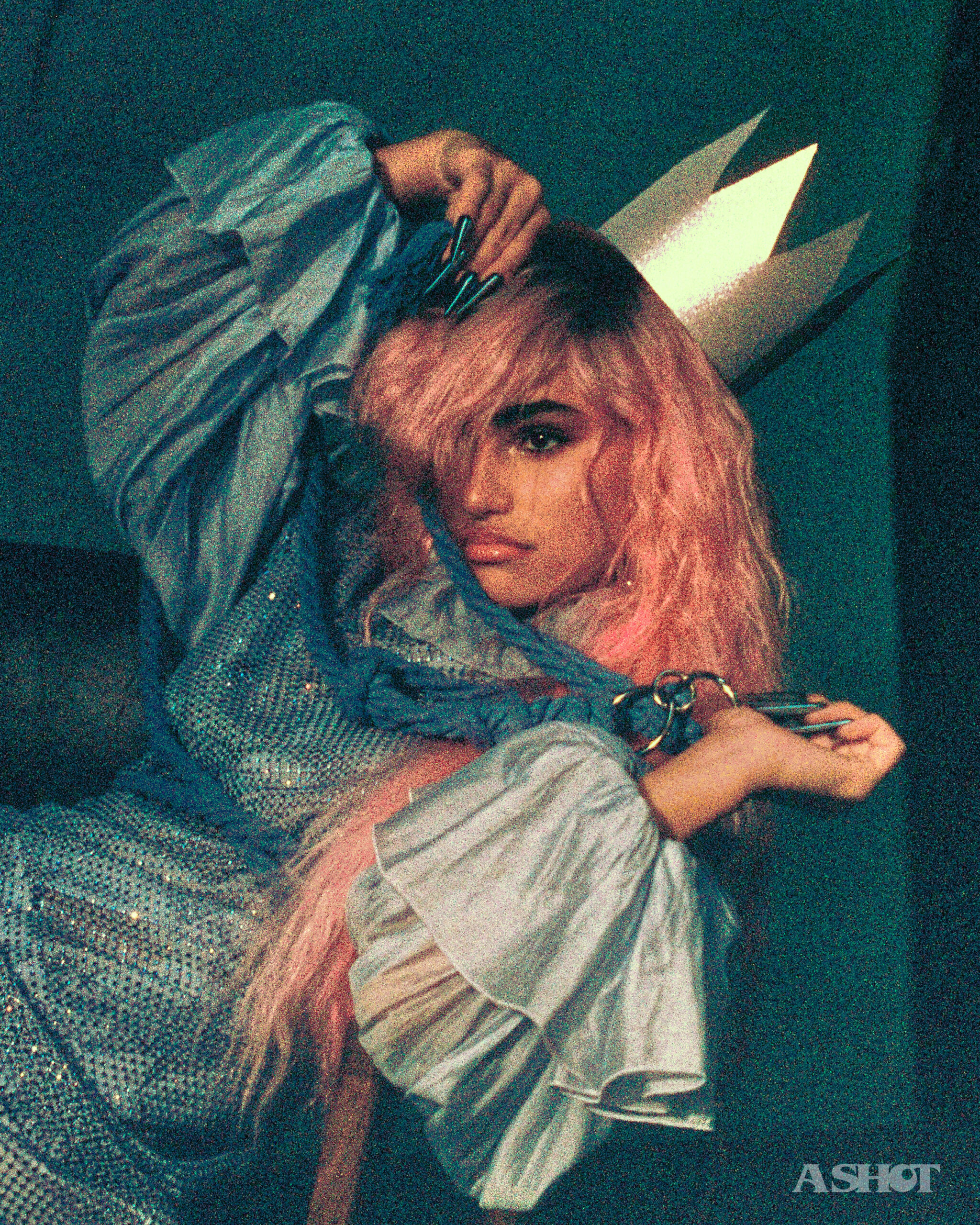
Dress @natashia.studio
Shirt @thelateststudios
Shoes @damayaofficial_
There is another difference she finds compelling: permanence. A competition is intensely immediate; you train, perform, receive the result and, sooner or later, the moment recedes. Film, however, preserves the performance. Vallandingham describes it as being “immortalized,” capable of reaching somebody years after the day it was made.
That might just be the clearest articulation of what acting has given her. Martial arts taught Vallandingham how to command a moment, but film, on the other hand, gives her the possibility of leaving something behind once the moment is over.
Emotional range, however, does not mean Vallandingham is in any hurry to trade fight sequences for romantic comedies. She can imagine one in her future, eventually. For now, she is more interested in characters who arrive armed. “I want to do badass stories where I’m fighting or holding a weapon,” she says. Her threshold for romance is similarly action-oriented:
“If I still get to beat a guy up, that’s a good rom-com.”
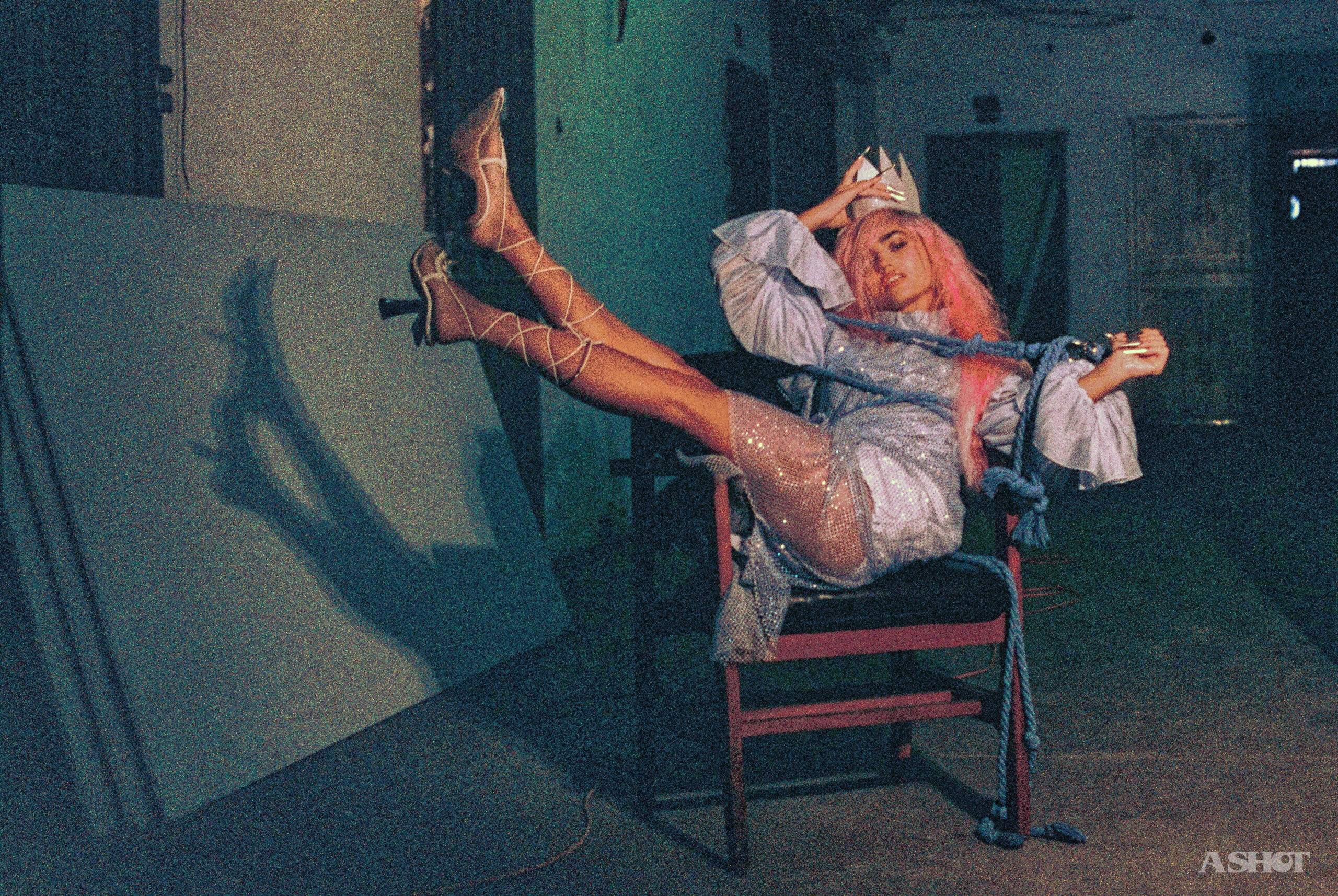
Then came the opportunity to join the upcoming Street Fighter film, scheduled to hit theatres on October 16th, and bringing several of Vallandingham’s earliest fascinations with it. She had grown up playing the game, part of the same childhood constellation that included Bruce Lee, Kill Bill and Mortal Kombat. She gravitated towards worlds where fighting occupied the center of the story and, within Street Fighter, towards Chun-Li and Cammy.
When the email arrived telling her she had landed a role in a universe she had been playing in long before Hollywood entered the equation, the convergence was difficult to miss. “It was such a dream,” she exclaims. “All of these things that I loved as a kid were coming together.”
Curiously, Juli, the character Vallandingham would play, was not one she had grown up choosing. With roughly three weeks to prepare, she immersed herself in gameplay footage and the character’s backstory, approaching Juli without years of personal attachment dictating what the performance ought to look like. “I didn’t really have any preconceived notions of who she was,” Vallandingham explains.
For someone stepping into a franchise with decades of history and an audience already intimately acquainted with its characters, that unfamiliarity offered an unpredicted freedom. Vallandingham could study the source material closely without being beholden to her own nostalgia, building Juli from what she discovered rather than what she remembered.
Juli presented Vallandingham with a peculiar challenge. She is a brainwashed assassin, fiercely devoted to Bison, a relationship Vallandingham spent time dissecting with David Dastmalchian, who plays him. The performance demanded an almost total evacuation of the expressiveness Vallandingham ordinarily gravitates towards.
Her posture became exacting. Blinking was kept to a minimum; movement was economical and methodical. Vallandingham imagined something almost serpentine, a body capable of violence without needing to advertise it. “I wanted her to feel almost machine-like,” she explains.
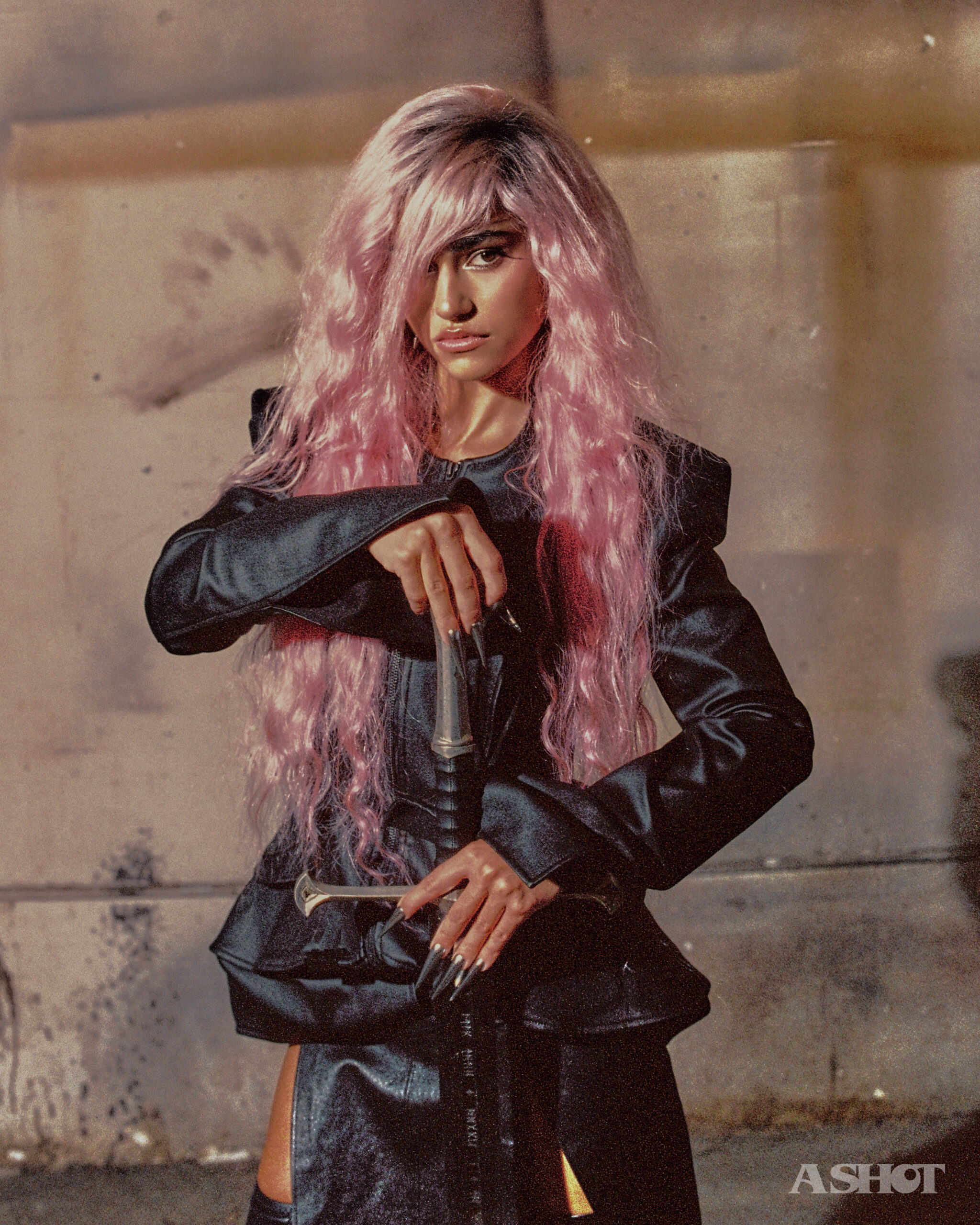
Coat @annakikiofficial
Skirt @heiraleatherwear
Shoes @gcdswear
Acting had once offered Vallandingham permission to access the vulnerability and emotional expression martial arts had taught her to contain. Juli asked her to contain it all over again. Instead of externalising every impulse through her face or body, Vallandingham concentrated the performance into stillness, allowing the character’s eyes to carry what the rest of her refused to reveal.
For an actor whose physicality is usually her most immediate instrument, learning how little she could do became its own kind of choreography. “It was almost like being a snake,” she says. “You’re still, but you’re watching everything.”
For all that preparation, one obvious form of research somehow escaped them. There were Street Fighter games on the Australian set, and Vallandingham and her castmates repeatedly made plans to play together. They never did.
Production had other ideas. Fight sequences were constantly being added, removed and reworked, leaving little of the downtime they kept imagining they would have. “We kept saying we were going to play, and we just never got around to it,” she laughs. Vallandingham already has a contingency plan should they return for another film: “If there’s a second one, I’m getting one myself.” Apparently, making Street Fighter leaves a lot less time for playing Street Fighter than one might expect.
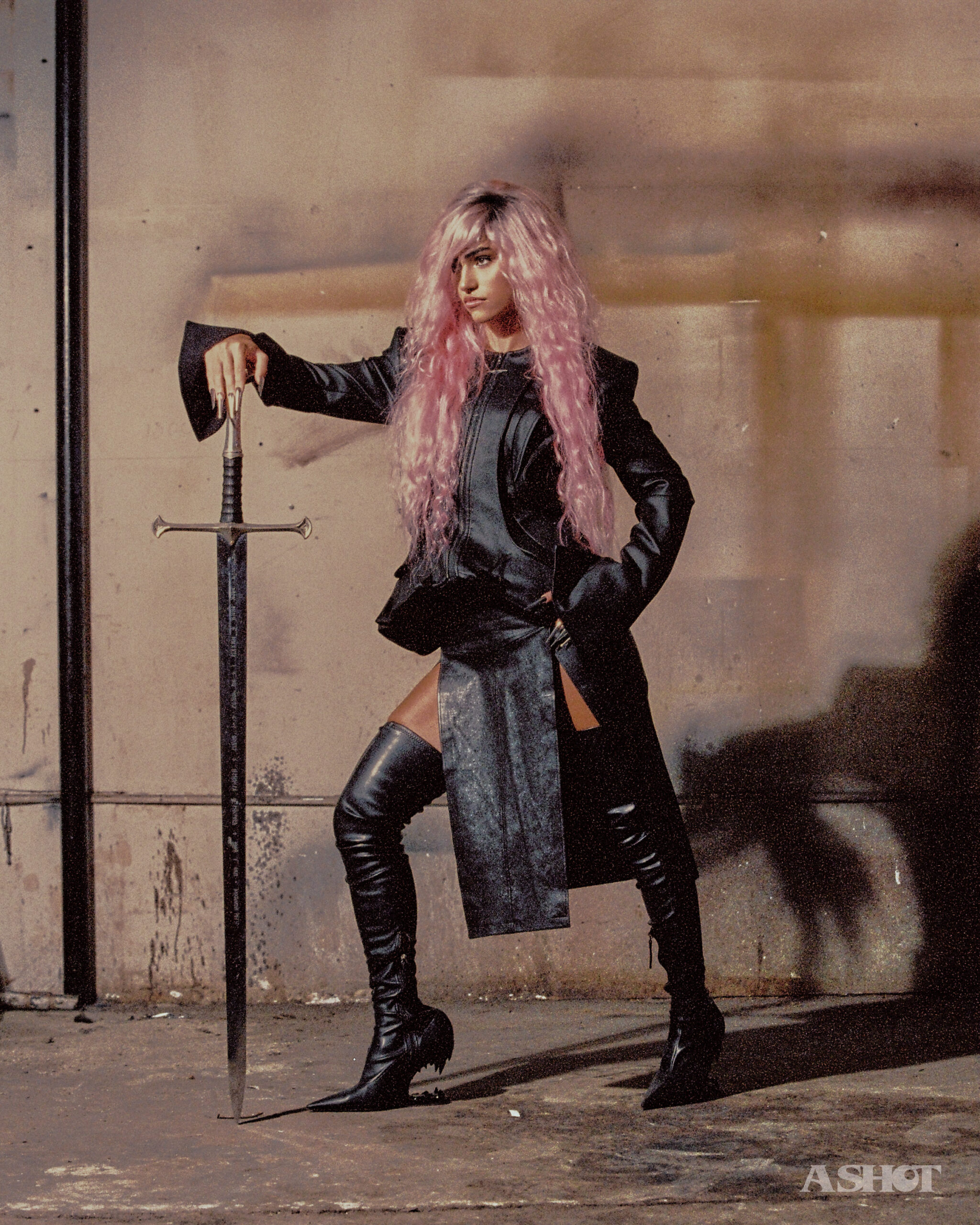
Coat @annakikiofficial
Skirt @heiraleatherwear
Shoes @gcdswear
Street Fighter was not Vallandingham’s first brush with a video-game adaptation. At 19, she auditioned for Mortal Kombat 2, a franchise already embedded in the same childhood canon that had formed her ambitions. At the time, she wondered whether it might be her entry point into the world she had spent years imagining herself inside. “I think I was just too young,” she says now.
In retrospect, she is glad the timing refused to cooperate. Street Fighter arrived later, when Vallandingham felt better equipped to meet it, and with a sensibility that suits her specifically well. She loves the franchise’s willingness to embrace camp, colour and absurdity, the fact that formidable fighters can exist inside a world that never insists upon taking itself entirely seriously. “It’s so fun and campy,” she shares to A Shot. “I love that about Street Fighter.” The opportunity she once thought she had missed had, in effect, merely arrived in a different universe
Ask Vallandingham which cinematic universe she would enter tomorrow and Kill Bill still wins. Lately, though, she has been making her way through X-Men, drawn particularly to Halle Berry’s Storm. Then there is John Wick, a franchise whose choreography she admires almost as much as the man at its centre. Working with Keanu Reeves sits high on the wish list. Her admiration comes with an instantaneous question:
“Where are all the women?”
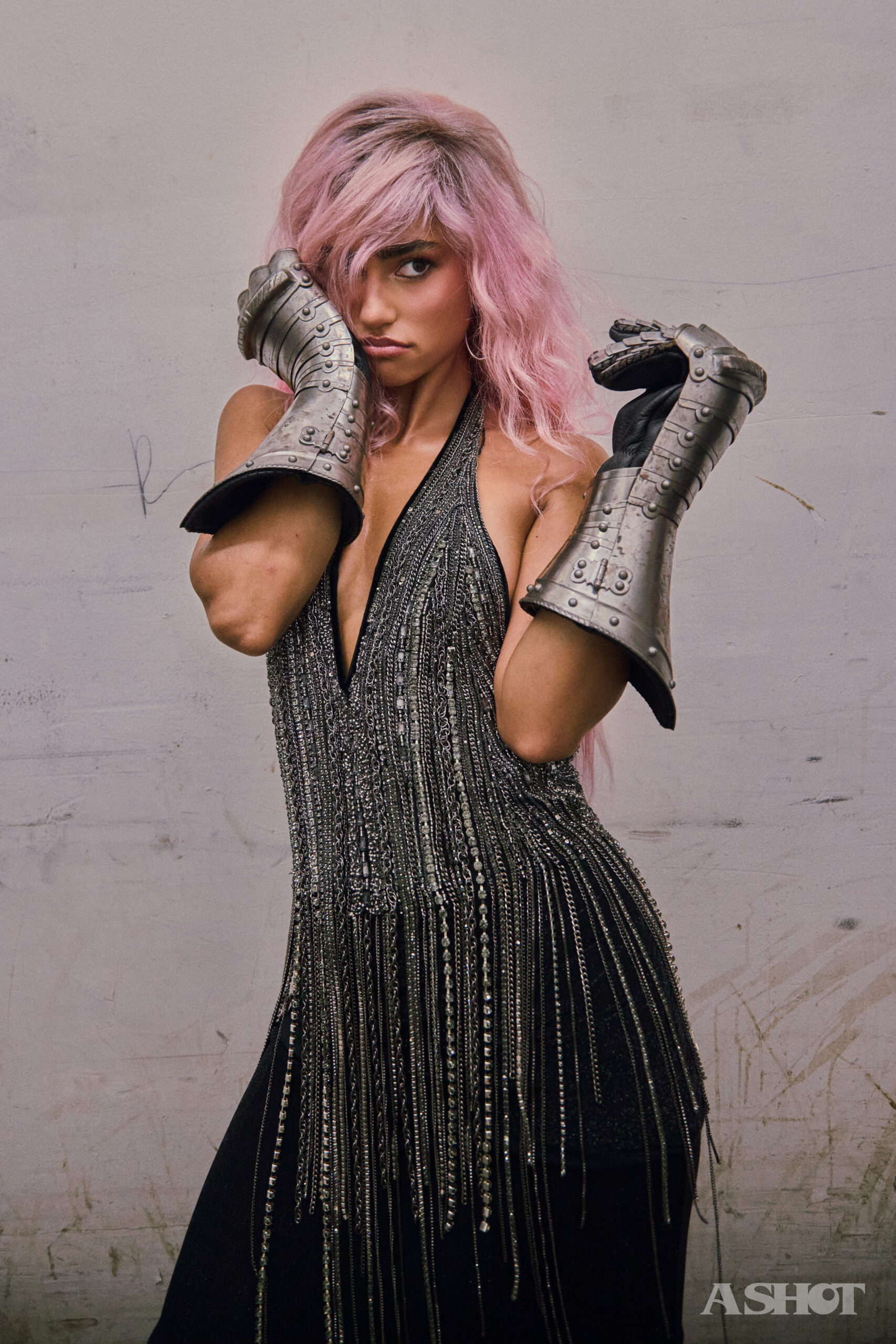
Dress @sarawongofficial
Gauntlets @balenciaga
Vallandingham wants to see more of them fighting. Michelle Yeoh, in particular, was formative, part of a lineage of women she credits with opening doors long before she was in a position to walk through them herself. However, she is conscious of what she hopes to add to that lineage: the perspective of someone whose relationship with combat predates her relationship with acting, and whose physical fluency was developed through years of genuine martial arts practice.
It brings her ambition back into focus. Vallandingham wants to widen the possibilities for women within the action genre and who gets to command its centre. The women she watched growing up showed her that space existed. She hopes to contribute something very much her own to it: the perspective of a lifelong martial artist whose instinct for fighting preceded her acting career.
For someone whose life has been defined by movement, Vallandingham has recently discovered the pleasure of disappearing somewhere extensively softer. Reading has become her primary escape, particularly fantasy, a genre capacious enough to pull her attention away from the physical demands of training and performance. She has made her way through around eight books this year, including A Court of Thorns and Roses, Throne of Glass, Fourth Wing and Iron Flame. “It’s the one thing where I can just turn my brain off,” she admits.
The timing feels acutely apt. An ankle injury has forced Vallandingham into her first substantial break from intensive martial arts training, temporarily interrupting the physical rhythm that has governed almost her entire life. She has found herself returning to Fourth Wing, where Violet Sorrengail’s perpetually injured body has become an unexpectedly comforting companion. “She’s always injured, so I feel very seen right now,” Vallandingham jokes.
Stillness does not come especially naturally to her. Even while talking about injury, she speaks in the language of return. She will recover. She will train again. She will, she insists, “come back stronger.”
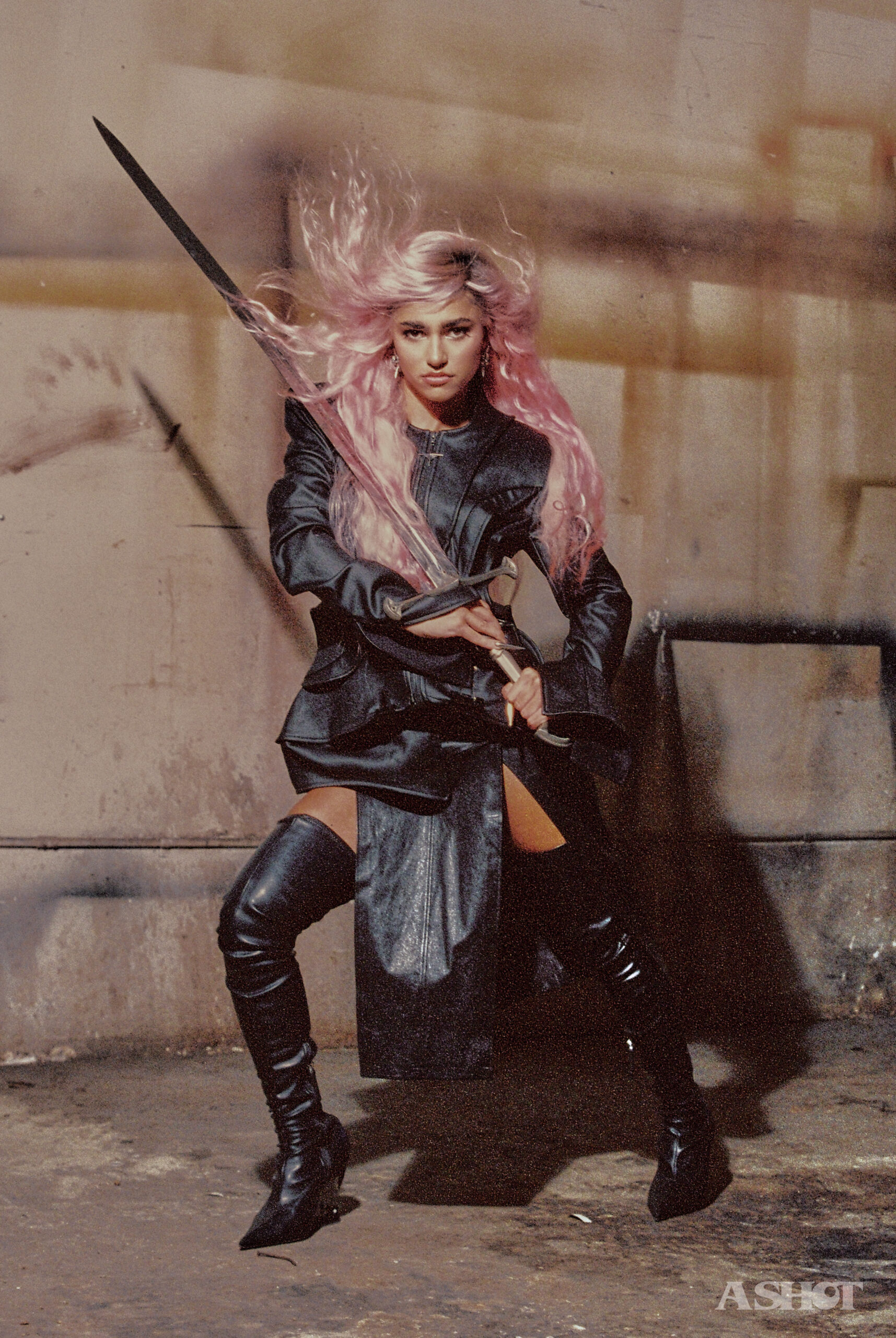
Coat @annakikiofficial
Skirt @heiraleatherwear
Shoes @gcdswear
Perhaps unsurprisingly, when asked to imagine herself as a single shot in a film, Vallandingham returns to the movie that first gave her an image of the woman she wanted to become. Her answer is Kill Bill: the overhead shot of Beatrix Kiddo surrounded by the Crazy 88, one woman standing at the centre of what should be impossible odds. Vallandingham knows the image intimately. It is, quite literally, the wallpaper on her phone.
What fascinates her now is not simply the choreography. It is the certainty with which the film allows Beatrix to occupy the frame. She is surrounded by men and hopelessly outnumbered, but the audience is never asked to question whether a woman belongs at the centre of that fight. She just does.
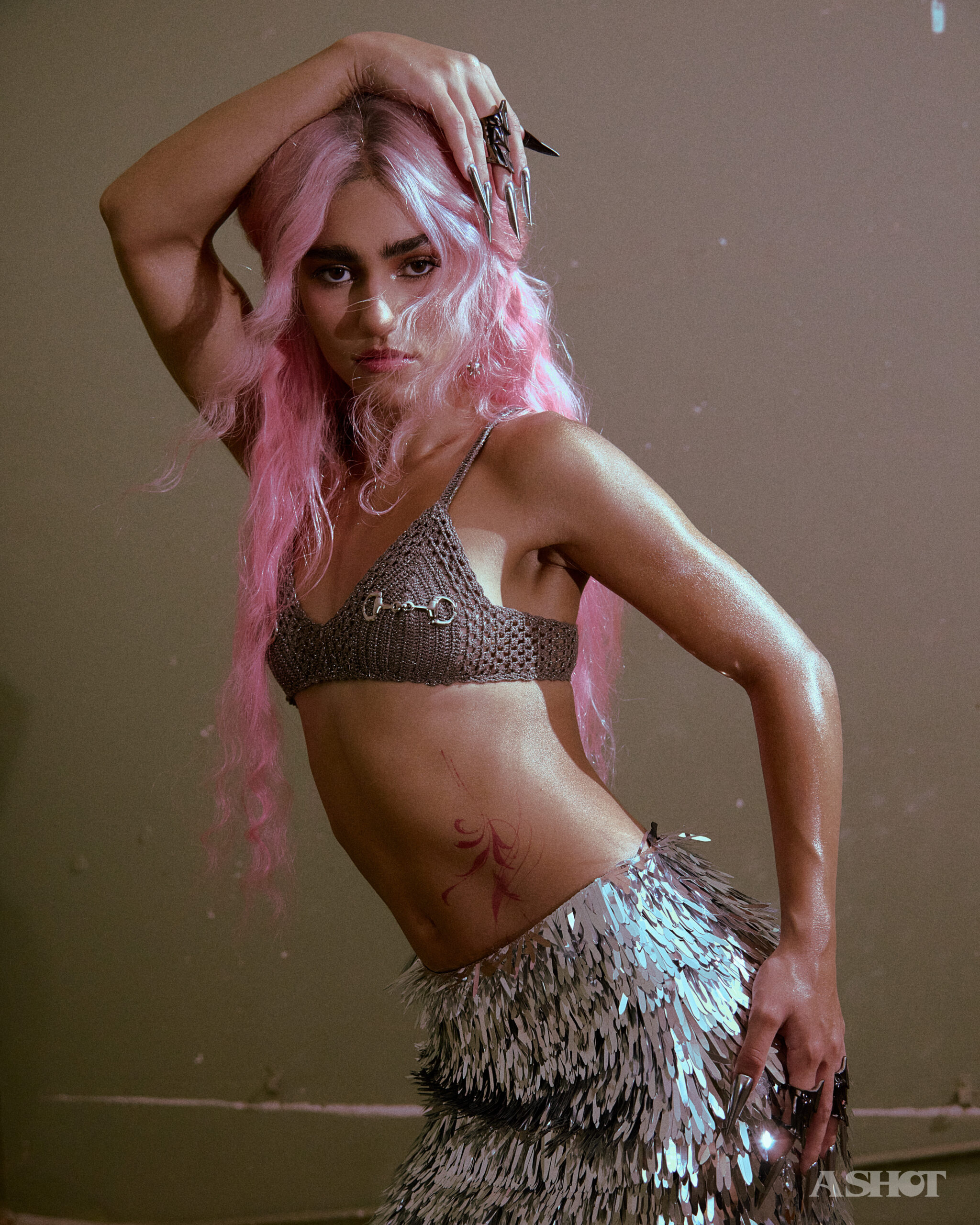
Bralette @shop_redemption
Skirt @annakikiofficial
Jewelry @rareromance
For the actress and performer, years spent navigating a male-dominated sport have made that image more resonant with time. Now entering an action industry where she still finds herself asking where all the women are, she understands Beatrix’s position at the centre of the frame differently. Six-year-old Rayna watched that woman surrounded by men. At 23, she still keeps her on her phone screen. Only now, Vallandingham is considerably closer to becoming the woman in the middle of the frame.
- Photographer: Jordan Kirk
- Styling: Kaitlyn Vitug
- Hair: Rachel Lita
- Makeup: Kelby Adam
- Nails: Rachel Sun
- Art Department: Hallie Gluk
- Location: @thunderdomestudiosla