By
I knew Nicolas Winding Refn through old interviews I had pored over, through the chaos and precision of films like Drive and The Neon Demon, and even through his hilarious and chronically online friendship with Hideo Kojima. I thought I had a sense of where our conversation might go, that my research would brief me for NWR in person. It was only when we were finally face to face, gearing to discuss his latest feature and Cannes smash hit Her Private Hell, that I realized this conversation would be akin to his films in a particular way you’ll never know what’s around the corner.
If Nicolas Winding Refn could be a single shot in a film, he would not choose an elaborate tracking shot, an imposing wide, or one of the saturated images bathed in neon lights that have come to define his work. His answer to A Shot’s signature question is much simpler:
“I would love to be a zoom lens that starts from a very tight close-up and pulls out to reveal the real image.”
On its face, I wondered whether this was one of the unadorned answers A Shot has ever received to the question. Maybe even one with the least thought put into it- said so confidently and without addendum. It was only when I listened back to our conversation that it began to feel unusually specific to Refn. Throughout our conversation, we had spoken about the afterlife, his heart stopping, daydreaming, his first time using storyboards, opera, Pino Donaggio, and an alcohol-fuelled Elvis Presley impression in Rome. Each subject seemed unmethodical in the moment, but this final answer connected them. This answer explains everything about NWR that came before.
For a filmmaker whose work is so often described through the visual, whether the neon cityscapes, pristine compositions, or graphic violence, Refn spends little time talking about images themselves. He talks about what exists beneath them or what lives inside all of us. Things like belief, fate, music, and imagination. The unseen architecture holding everything together.
Her Private Hell is perhaps Refn’s clearest expression of his thoughts on our inner world to date. On paper, it’s a science-fiction opera, per his words, following Sophie Thatcher’s Elle who is navigating a broken relationship with her father’s new wife, and *spoiler* her previous lover, played by Havana Rose Liu, all while Charles Melton’s enigmatic Private K descends into hell itself while searching for his missing daughter. It contains cyberpunk skylines, operatic family drama, a classic symphonic score and all of the usual horror, fantasy, violence, romance, camp, and melodrama. And lots of references to hell.
“The title suggests one private hell,” I mentioned. “But by the end it feels like everyone has their own. Do you believe hell is somewhere we go or something we carry with us?”
“That’s a very interesting question,” he says. “I would think that we all carry hell around with us… I think we’re all stuck in it, in some kind of promise that if we live our lives well enough, with enough dignity, we’ll go to heaven. But hell is on earth.” It’s a bleak sentiment, until he softens the blow for me.
“Not necessarily in a negative way. I think most people live in comfortable pain.”
‘Comfortable pain’ summarizes much of Refn’s filmography better than a conversation around aesthetics ever could. His characters famously drift through states of longing, obsession, desire, grief, and transcendence, searching less for escape than for meaning inside whatever private purgatory they’ve inherited. That fascination with invisible suffering inevitably leads us toward faith.
The conversation naturally moves from hell to religion, and then to Refn’s own encounter with death. Several years ago, his heart stopped for a long period of time before he was ultimately, thankfully, revived. The experience has since become part of his personal lore, even shocking those in attendance at the Cannes film festival panel where he broke into tears when recalling the scary moment.
As a superstitious person myself, I was mostly interested in Refn’s feelings on coincidence and luck, for reasons I have not seen dissected online: Refn had previously appeared in Hideo Kojima’s video game Death Stranding as Heartman, a character who repeatedly stops his own heart in order to search the world of the dead for his family. Much like the character, his heart came back to life after stopping for an extended period. Refn is amused by the coincidence but resists turning it into mythology.
“It’s Hideo’s creation. I’m just the eye candy.”
Created by his own good friend, the character existed years before Refn’s own cardiac arrest, although “the irony was that it certainly began to have similarities in my own life. It is kind of ironic that I’m called Heartman in a video game and my heart stopped,” he continues. “But then it was able to start again. Like in the video game, I came back.” When he describes what he experienced while his heart stopped his answer is rooted mostly in his role of being a father, yearning for more time to make things that matter for his children.
“The afterlife is tricky, because for me it just went black. There was nothing there. But I was always very determined to come back. I remember asking God if I could just have five more minutes. That’s all I would ask for. I wanted to come back and make things that mattered for my children.” Refn recalls no vision of an afterlife, just blackness, but he also recalls addressing God and asking to return.
“I think everyone, at one point in their lives, will turn towards faith at the most pivotal moment of their existence,” he says. “Faith is a very fundamental foundation of being a human- a soul. What you believe in and how you believe in it is a very different situation from person to person, but I very much believe faith is a foundation.” His thinking about faith also overlaps with the way he understands filmmaking. When I ask whether making films has changed his relationship to faith, rather than simply allowing his beliefs to influence his films, he brings another word into the conversation: fate.
“You’ve got to have faith to create. You’ve got to believe in yourself and that the higher powers will protect you in whatever you end up doing. But I also believe in fate, because certain things have happened that almost feel like they were meant to be. God had a plan, as they say. So, you’ve got to roll with the punches and see what happens.”
Belief, in this context, is practical. A filmmaker has to commit to something that does not yet exist, persuade other people that it can (and even harder: should) exist, and continue working through the often very long period in which the completed film remains largely imaginary. Refn’s faith in the creative process is not presented as optimism so much as a prerequisite for making anything at all.
That leads us to dreams. Refn’s recent work, including Too Old to Die Young, Copenhagen Cowboy and now Her Private Hell, often feels suspended between waking life and a more hellish dreamscape. I ask whether he remembers his dreams or gives them any particular importance. “I’m unfortunately not able to remember my dreams,” he says. “I’m so envious of people who have this ability to wake up and say, ‘I had this amazing dream,’ and turn it into a novel, or a movie, or a song. I don’t have that.” What he does have is an ability to disappear into waking fantasies.
“Daydreaming… that I have a lot of. I can zone out into my own imagination and stay there for hours. Maybe that’s my substitute.”
His mother could always tell when it was happening. “When I was a lot younger, she could always see when I was in my own world, because I would either talk to myself as if I were in a conversation, or I would giggle.” It’s a sweet image of a filmmaker whose work is often described as cold, violent or confrontational. Refn talks about imagination with an almost childlike protectiveness. Not as something mystical or reserved for artists, but as something everyone has access to if they’re willing to make space for it and nourish it. I appreciate this sentiment as more and more I too wonder how to tap into my childlike
“You fall into it,” he says of daydreaming, “and then sometimes you’re trying to claw your way out of it to go back to the real world, which is not always the most fun place to be.” He is conscious of maintaining access to that private world and wants others to do the same.
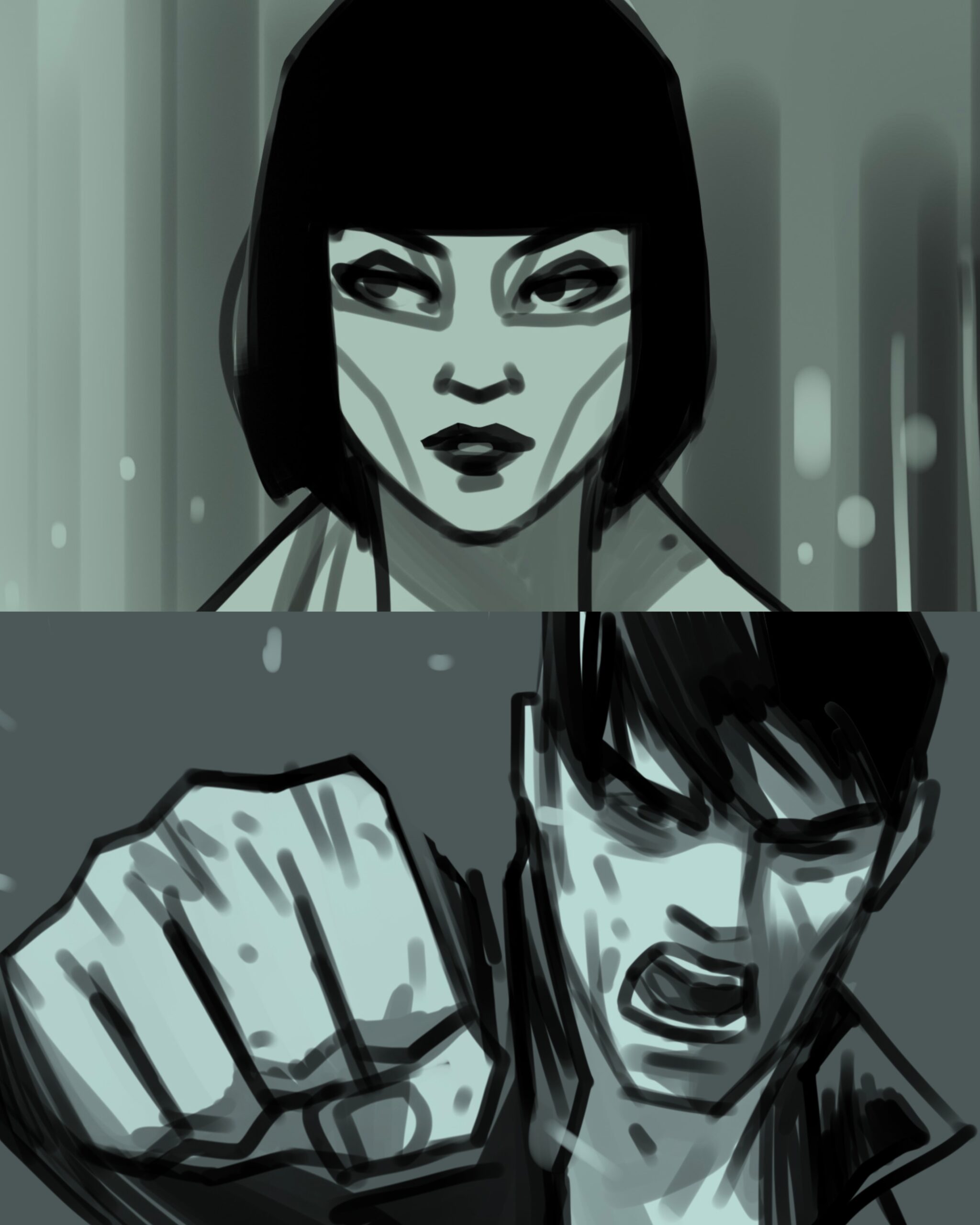
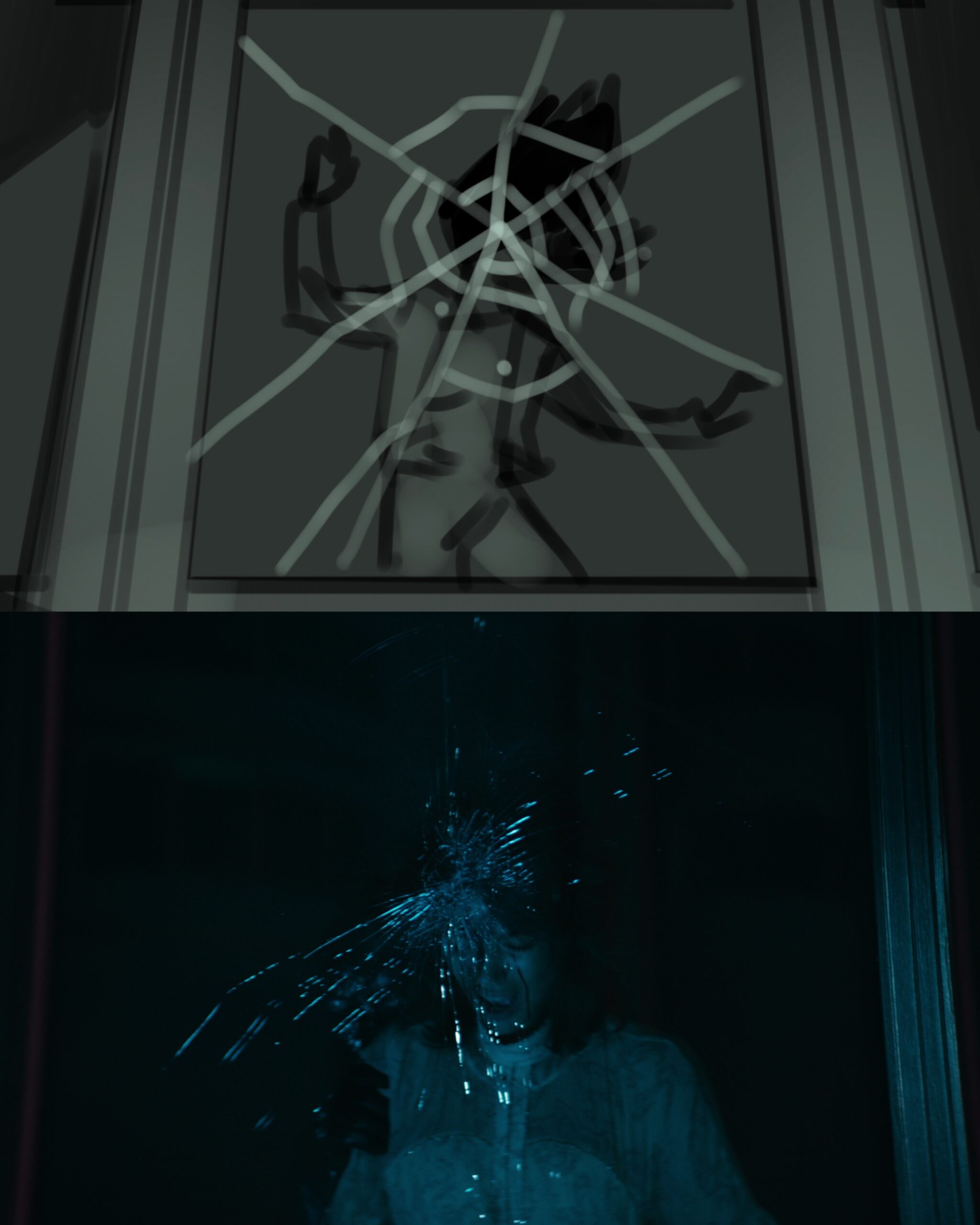
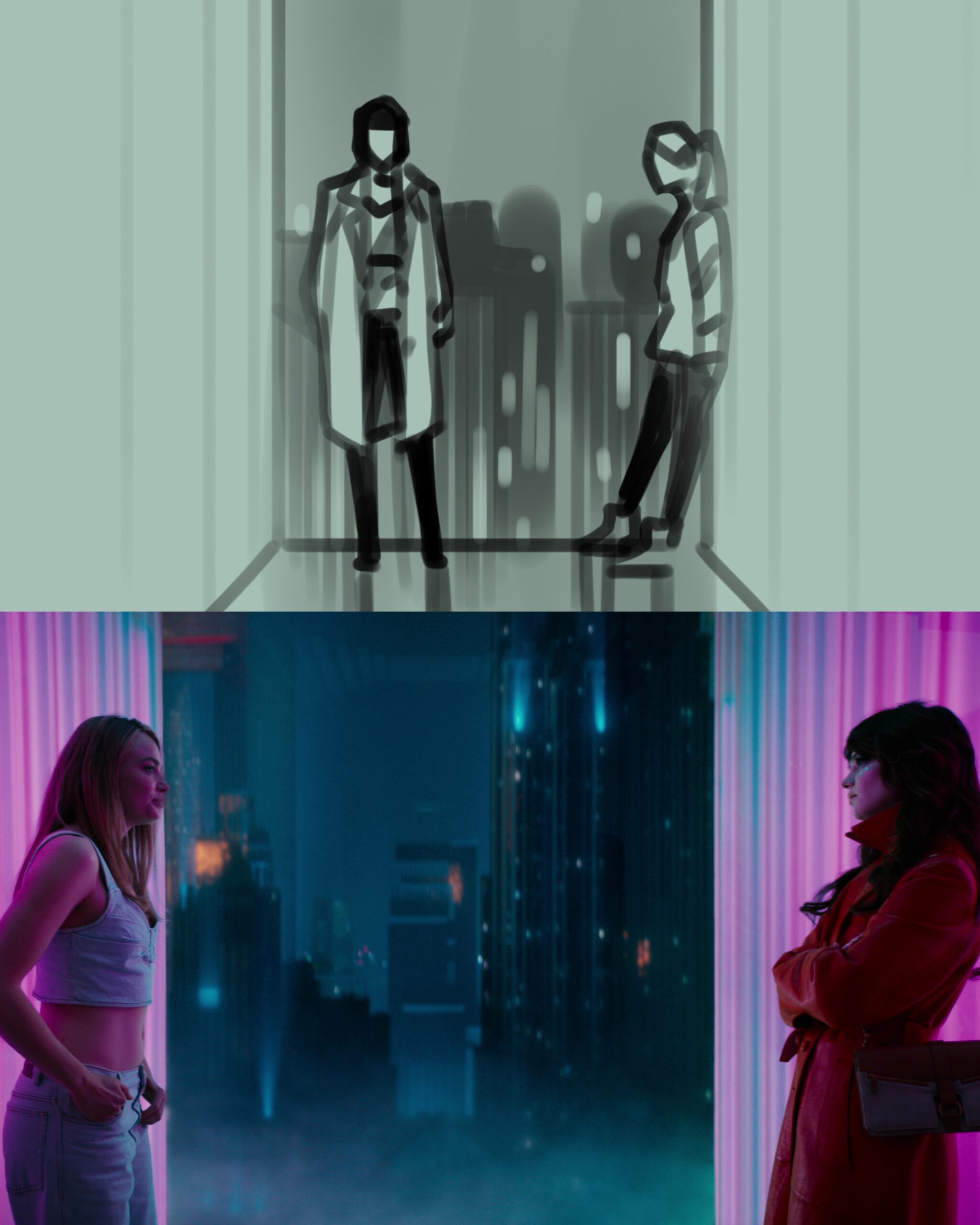
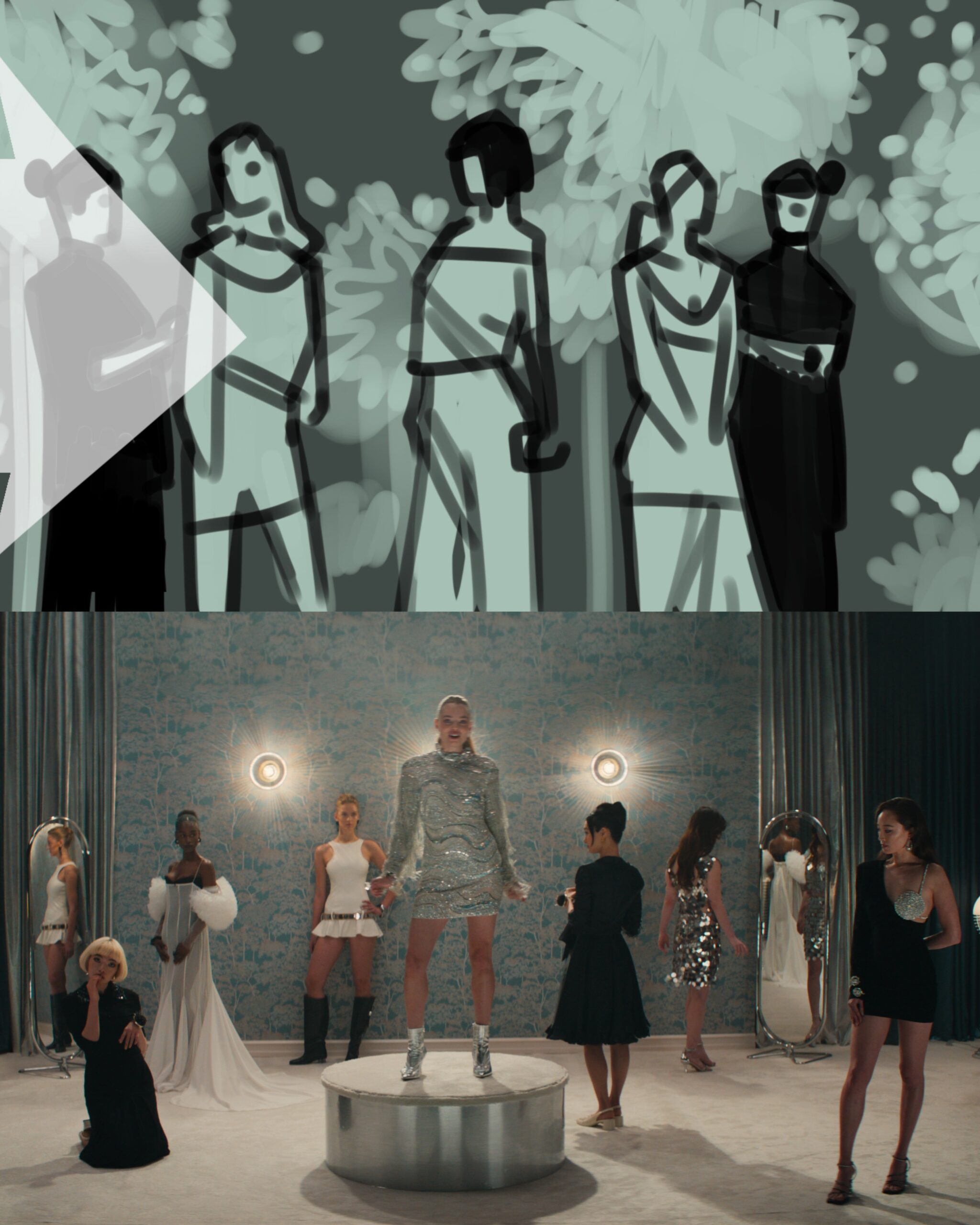
“You have to protect your imagination. You have to remember that imagination is a wonderful gift that everyone is able to access. But you also have to nourish it, support it and protect it.” That reliance on imagination makes one element of Her Private Hell’s production especially interesting: it was the first film Refn had storyboarded in extensive detail. The decision was not initially philosophical. It was logistical. The production had limited funding and limited time, leaving little room for experimentation once filming began.
“Everything had to be very specific,” he explains. “There was not a lot of time to test things. We had to be very productive.”
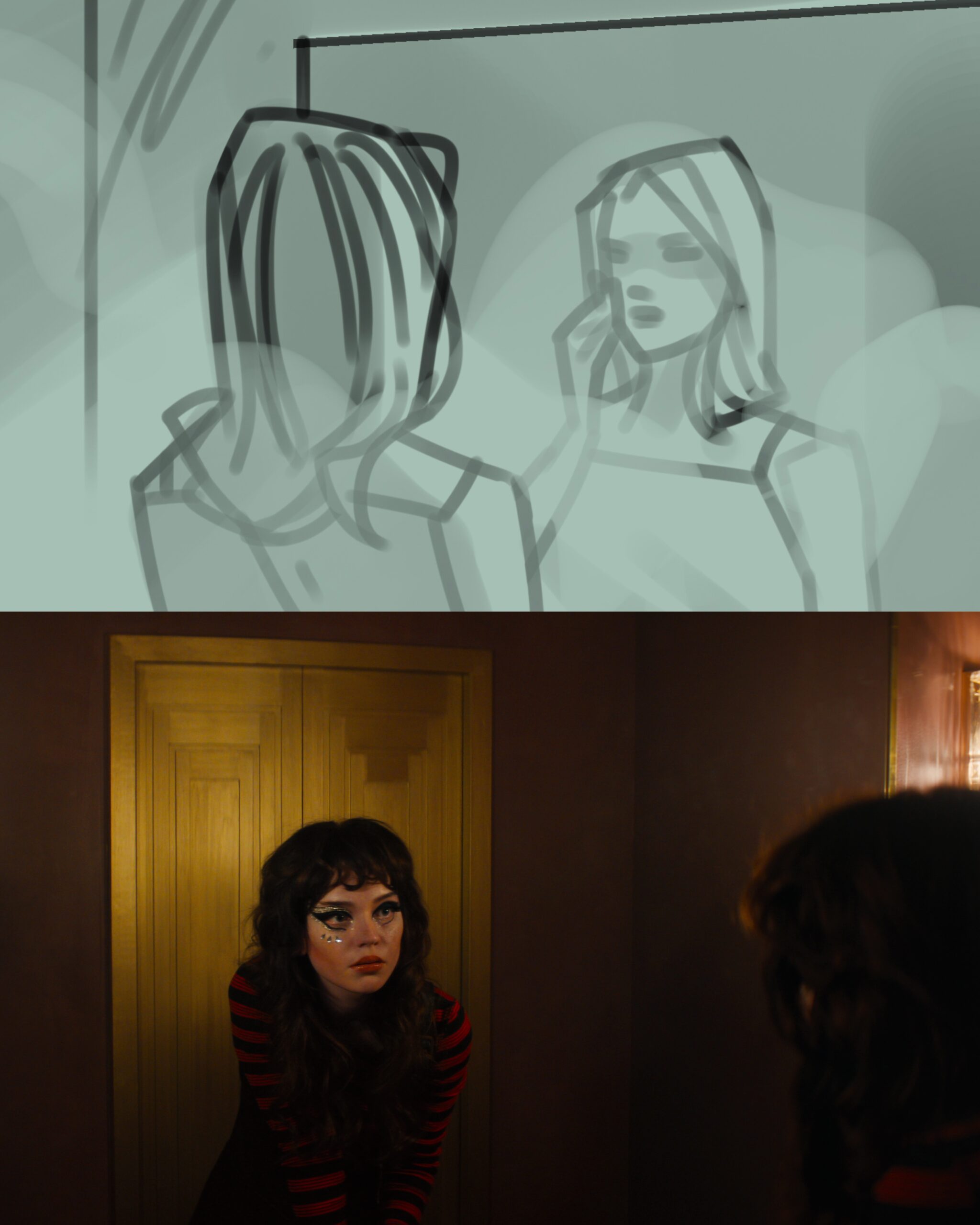
The storyboards were displayed in the production room so that the crew could follow the film’s structure. Refn supplemented them with reference images and what he calls “sensibility images,” allowing collaborators to understand not only the intended composition but the feeling he was trying to produce. “That led to more and more collaboration, because now the whole crew could really see the film,” he says. “They could see what it was all supposed to turn into.”
There is a useful tension in the method. Her Private Hell is deliberately dreamlike and emotionally excessive, but its production required unusual precision. The private vision had to become legible to an entire crew. Refn does not suggest that storyboarding will now define his process. His next project, he says, will be approached completely differently, but for this film it gave physical order to a world governed by unstable emotions. This idea of controlled chaos is a theme that continues to echo.
The film’s musical identity developed in a more spontaneous way. Refn initially assumed he would use an electronic score, as he had on many of his previous projects. During production, however, he found himself moving away from that idea without immediately understanding why. “I was leaning away from it more and more, and I didn’t know why I was suddenly so hesitant,” he says, “until I realised it’s because I wanted to make an opera. I just didn’t know it.”
Once he understood the film as an opera, its seemingly incompatible elements began to make sense together. Elle’s father leaves her and marries her former lover, who becomes her stepmother. Elle imagines an alter ego in Private K, who descends into hell. The relationships are heightened, painful and, as Refn puts it, “very operatic in grandiose ways.”
“There’s a lot of drama, a lot of melodrama and a little bit of camp,” he says. “The movie had to have everything I desired- from horror to sci-fi to action, fantasy, melodrama, kitsch, camp, sex, violence and color.”
The challenge and therefore goal was finding something that could hold all of those together, allowing them all to exist in harmony. This is where the operatic element enters. When watching the film, the score takes you by surprise only to shepherd you through the maze that is Her Private Hell. It warms you to the cold characters, adds a bit of oomph to otherwise unhurried scenes, and ultimately delivers a feeling of transcendence, or maybe even descendance. The answer to Refn’s needs was music, although he had arrived at it in reverse. In a sort of Frankenstein twist, Refn had already built the body of the film, and needed someone to get the blood flowing.
Refn went to Italy in search of one of the composers he associated with the tradition he wanted. “All the composers that you and I would probably refer to are dead. The only one alive was Pino Donaggio, and he was in his mid-eighties.” Donaggio, whose long career includes collaborations with Brian De Palma and scores for films including Carrie, Dressed to Kill and Blow Out, had written music for hundreds of films. Refn contacted him with a fairly direct proposition: “Do you want to write an opera?”
Donaggio said yes.
“The man has scored over 300 movies, so I don’t think anything was scary to him,” Refn says. “But it was scary to me.” Refn understood that the score would either unite the film’s many competing elements or expose how precariously they had been assembled. He remembers explaining the pressure to Donaggio in anatomical terms.
“You’re the most important person on this movie right now,” he told him, “Because you’re going to take this entire house of cards that I’ve built. There’s a heart in there somewhere, and I know where it is. You’re going to have to provide the blood. Because if all these veins running through the film from the heart are empty, the house of cards is going to fall apart.”
It is almost uneasy to hear the metaphor without thinking about Refn’s own heart, even though he does not draw the connection himself. For him, the image is primarily structural: the film already contained its main emotional idea, but Donaggio’s score had to circulate it through every scene. Refn compares the decision to arriving at a roulette table with a single chip and placing it on black.
“And it won,” I say.
“And it won,” he agrees.
After completing the final mix in Rome, Refn, Donaggio and the composer’s team went out for a celebratory dinner. Donaggio had slightly too much wine and began imitating Elvis Presley, as one does. “I thought, wow, this is really cool,” Refn remembers. “It’s not going to get any better than this.” It is a funny, ordinary ending to a story about building an entertaining, thoughtful, emotionally troubled, and hazy nightmare. Large ideas such as God, death, hell, fate and the nature of imagination, were repeatedly brought back to specific memories and simple decisions. Faith becomes asking for five more minutes. Imagination becomes a child giggling to himself. Opera becomes an elderly Italian composer performing Elvis after dinner.
Listening back, his final choice of a zoom lens feels less simple than it first appeared. Refn’s answer is not about creating a beautiful image so much as changing the audience’s understanding of one. A close-up gives you intensity and a specific angle on the story, but it withholds context. Only when the lens pulls back can you see how everything truly relates.
Her Private Hell works in a similar way. Its characters appear to inhabit separate stories and separate underworlds, but gradually those private experiences begin to overlap. Its genres compete until the music reveals them as parts of the same opera. Its fantastical hell is inseparable from the emotional conditions its characters already live with on earth. Refn begins with the private image and then enlarges it. The heart, the blood, the faith, the pain and the daydream are all already there. The zoom simply reveals how they fit together.
Now playing in theaters.