‘Yunan’ Review: Malick and Tarr Would Kill for a Main Actor like Georges Khabbaz
By
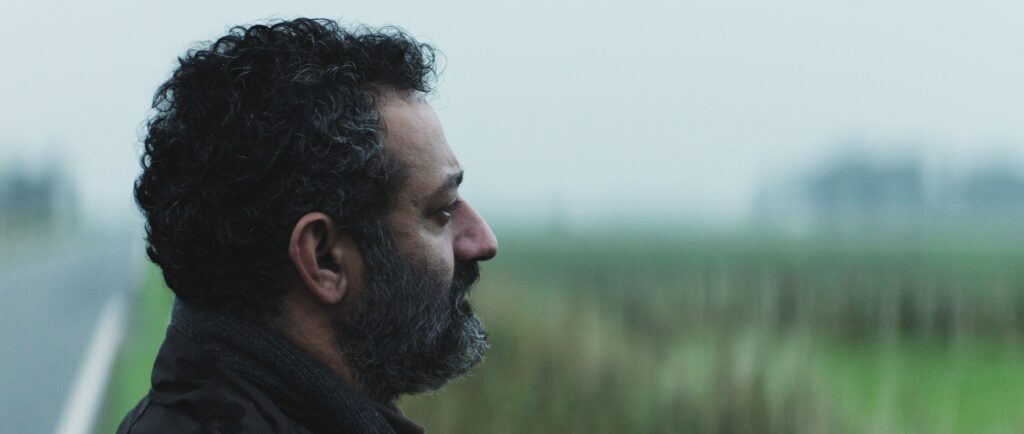
In a jaw dropping Canvas, Munir Noureddine stands alone in a yellow field, the golden sunbathes him and a flock of sheep. An angry, heavy look in his face, his eyes are as wide as the eyes of a child, and his beard like the beard of a prophet. The clouds are as thick as the darkness and longing in his heart; the wind and the deep blue waves violently express the feelings that he himself is holding back.
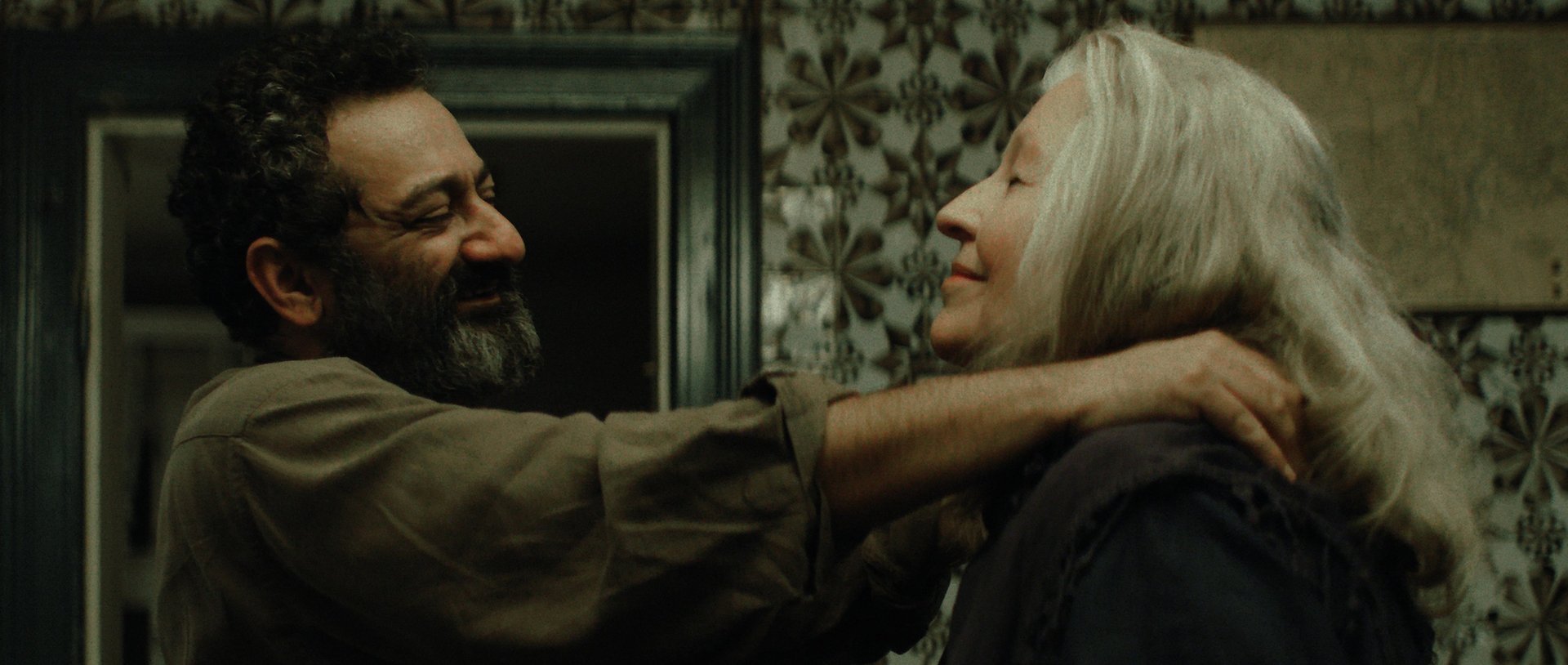
“Yunan”, the second feature from emerging Arab filmmaker Ameer Fakhr Eldien, is more interested in showing this sadness than explaining it -perhaps to a fault-, but there are reasons of course, Munir is exiled to Europe, unable to return to his own land (without much context as to “why”), he communicates with his family via calls, he helplessly witnesses from afar as his old mother gets dementia and starts losing her grasp on reality. He is unable to form any deep connection to anyone and is (of course) a writer with writer’s block.
There are clues that this is somewhat autobiographical: Munir Noor Eldien is a very similar name to Amir Fakhr Eldien, The fact that he is a writer, and that this is the second film in a trilogy of Isolation and Exile (That started with Munir’s previous film: The Stranger) But the vagueness in explaining the cause of this pain could be another clue, a sense of familiarity, that there is nothing to explain, that’s how it always has been.
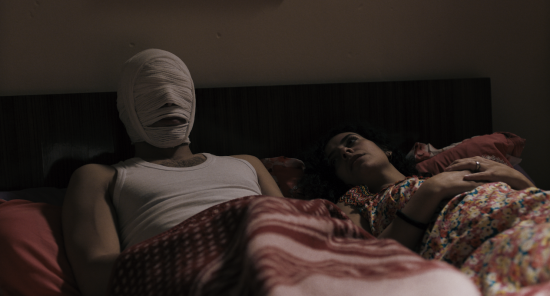
So, what does the film do instead of giving backstory? It makes Munir go to a rural German motel in the countryside to try (and fail) to kill himself. And has a second storyline that happens in a dreamland or a distant memory or an old tale, or rather, a childhood tale that you heard so many times when young that it feels like a real memory, that of a shepherd that has no name, no mouth yet must scream, and his beautiful wife that carries a heavy heart, the reasons for which are only known to her sheep and her husband (and obviously not to us, but maybe to Munir).
So “Yunan” is a mood piece, a series of stunning strong images after another, dangerous yet beautiful scenery where the camera stands still, unable to move, but only rotate in place during many panoramic shots. It is a more stripped-down version of a Tarkovsky, or more closely: Bela Tarr and Andrey Zvyagintsev
“Yunan” is another name for the biblical prophet Jonah, and the film features the giant whale that was also alluded to in Bela Tarr’s “Werkmeister Harmonies” and Zvyagintsev’s “Leviathan”. And perhaps the story of Jonah is the most “atmospheric” story out of all prophet stories, a story of raging storms, a deep ocean, and the darkness of the inside of a whale. Out of all those loose adaptations of Jonah, Yunan is perhaps the most biblically accurate due to how skeletal and broad it is.
This skeletal ness and sense of ambiguity could be too detrimental for the film. There are things to unpack and mysteries to contemplate, but the film isn’t always inviting for you to do so. So, you’d find everyone agreeing that the film’s best two things are Ronald Plante’s striking cinematography, and Georges Khabbaz’s incredible performance. Bela Tarr and Terrance Malick would kill to have an actor on their film like Khabbaz, an actor so vulnerable yet so able to be in touch with nature, an actor whose body feels like an erupting volcano, whose movements like ocean waves carrying the wrath of God, whose eyes feel like clouds weighted by rain that will rain down any time now. He glues the film’s desolate elements and ideas together and is the element that gives the film the most sense of cohesion.