Avatar: Fire and Ash: An Unsatisfying Return to Pandora
By
Avatar has always been divisive, loathed by some but loved by many. I’ve always championed these films for the same reasons that James Cameron continues to make them: they quite literally defy the boundaries of not only filmmaking, but storytelling.
When I watched Avatar for the first time at nine years old, any and all preconceived limits of art exploded into the most immersive adventure I had ever seen. I felt the same when I saw The Way of Water as a 22 year old. Some critics felt the complete opposite, with both Avatar and The Way of
Water being praised for their beauty yet criticised for their repetitive storylines and predictable characters. These critiques have never made sense to me, in part because of my relentless appreciation for James Cameron’s work, but also my belief that these films are excellent blockbusters imbued with a lot of heart and plenty to say. I can’t tell you how eager I was for this third installment to conjure the same feelings of joy that I have always found in this universe – it brings me absolutely no pleasure to say that Fire and Ash didn’t.
Avatar: Fire and Ash is a direct continuation of The Way of Water, and although the exact period of time between the two films isn’t clear, it’s safe to assume it’s somewhere in the range of a few weeks.
The Sully family are still residing with the Metkayina, the Na’vi water clan introduced in The Way of Water, led by the commanding Tonowari (Cliff Curtis) and stoic Ronal (Kate Winslet). Jake and Neytiri are at odds following the death of their oldest child, Neteyam (Jamie Flatters), their usual united front fractured by the weight of their grief. Their kids, Lo’ak (Britain Dalton), Kiri (Sigourney Weaver) and Tuktirey (Trinity Jo-Li Bliss) seem more settled into their new home, alongside their adoptive brother of sorts, Spider (Jack Champion), the abandoned child of antagonist Colonel Miles Quaritch (Stephen Lang).
Fire and Ash doesn’t lure you into the same initial sense of familial bliss that The Way of Water does, instead opening with a rather emotional reunion that serves as a reminder of what the Sully family have just endured.
Lo’ak, our new narrator, sets the film’s darker tone almost immediately, reminding us that “the fire of hate leads only to the ash of grief.” But the Sully’s can’t help but hate what’s happened to them, and splinter because of it. While ex-Marine Jake scavenges the reef for combat weapons, Neytiri, still dressed in her funeral attire, scrambles for comfort in Eywa, her dead son’s songcord clutched in hand, meanwhile Lo’ak, more distant from his father than ever, continues to blame himself for his brother’s death.
And of course, the Sky People return to make matters even worse: Quaritch is still desperate to satisfy his vendetta against Jake and ‘rescue’ his estranged son Spider, while the RDA are more committed than ever to their resource harvesting and colonisation schemes. Much of this set-up is identical to that of The Way of Water, until we’re introduced to the Mangkwan, a fiery, ash dwelling Na’vi clan that give the film its title.
Led by the terrifying Varang (played by the standout Oona Chaplin), these Na’vi have forsaken their connection to Eywa in favour of an inherent violence that catches the eye of Quaritch. Before long, a third party has joined the hunt for Jake Sully, and we’re thrown into the groundbreaking, blockbuster action that only a trip to James Cameron’s Pandora can muster.
Once this initial exposition is out of the way, Fire and Ash seems to prioritise its visual prowess over any commitment to its storytelling. This certainly is a beautiful film, bursting with dynamic action – an early scene involving the kids and the tulkun is truly jaw-dropping. It’s a perfect example of the magic that Cameron has created on Pandora, a sequence that leaves you wondering how he has pulled off a calibre of filmmaking that should be impossible. But as the runtime ticks down, Fire and Ash relies too heavily on this wow-factor, and everything else suffers, particularly the arcs of some of the most important characters. In between its moments of sprawling, physical conflict, the Sully’s, our protagonists, are fractured.
This is established early on with Jake and Neytiri handling their grief very differently, and butting heads because of it. They have some explosive conversations in the wake of Neteyam’s death that feel forgiven far too quickly, with so much left unsaid in between. Whether this is intentional, an act of showing their desperation to stick together, I don’t know. But the race to forgive everything so fast leaves very little space for any satisfactory resolution.
The same can be said for Jake and his teenage son, Lo’ak. A considerable distance has grown between them since The Way of Water, despite their brief but apparently meaningful reconciliation at the film’s end (“I see you, son”). Lo’ak feels responsible for his brother’s death, and his dad does little to convince him otherwise. Jake is still in full Marine mode, often more of a squad leader than a father, but he comes down hard on Lo’ak in a way that feels like a massive disservice to his character. Lo’ak, convinced he is a problem that needs to be dealt with, teeters on the edge for much of this film and his anguish culminates in a devastating moment in the middle of the film that is ultimately, and bizarrely, never broached again.
He goes it alone most of the time, fighting for his tulkun brother, Payakan, and is routinely dismissed by the elders around him. Maybe my hope for an earnest conversation is misplaced in this particular fictional universe (although it’s never felt that way before), but Jake and Lo’ak engage in a repetitive, heartbreaking cycle of blame and resentment that never reaches a point of actual resolution, which feels particularly egregious in this case considering the place that Lo’ak is pushed to. It’s pretty impossible to refute the ‘Jake is a bad dad’ claims after this film, too, for more reasons than one.
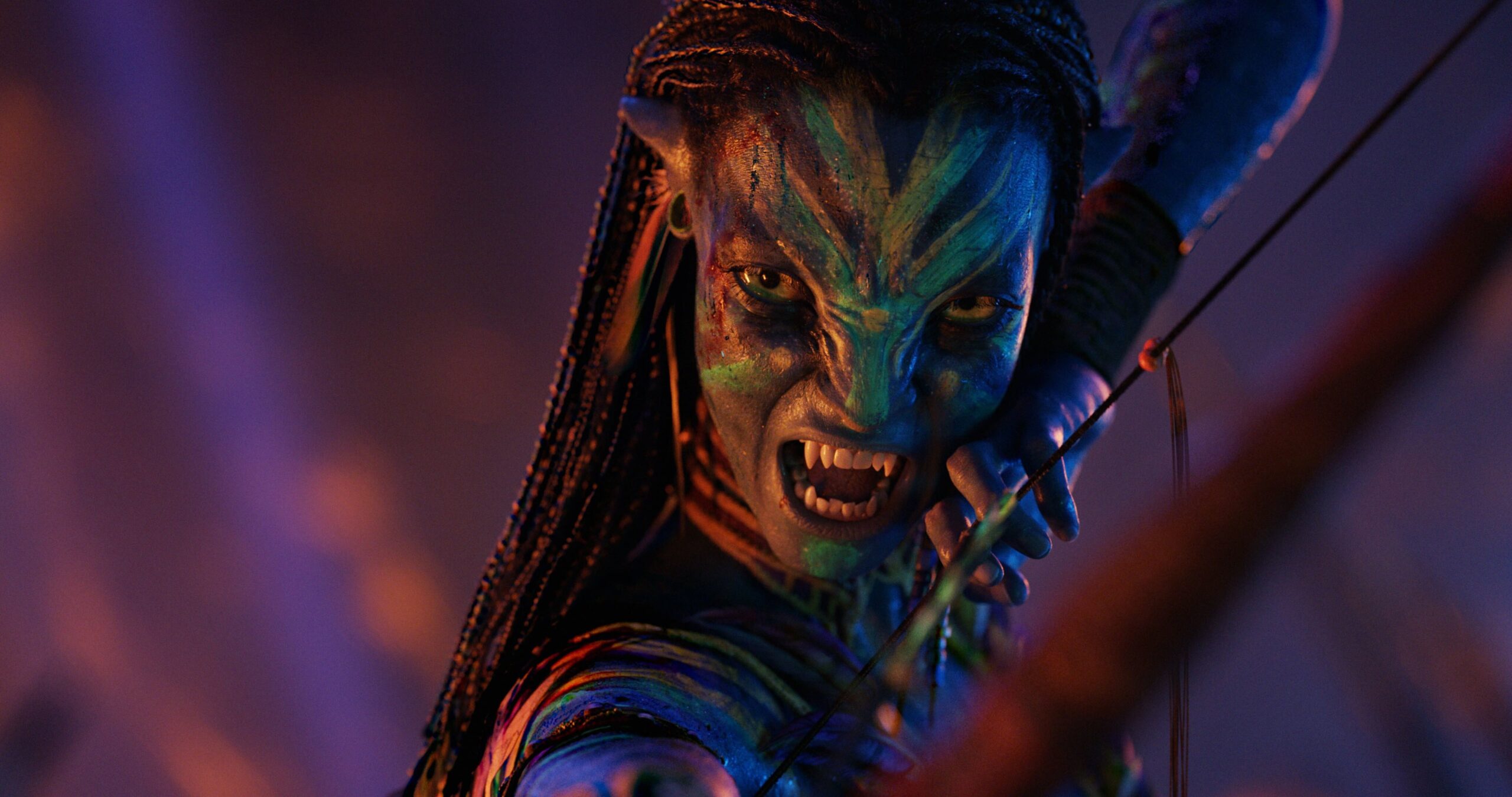
This repetitiveness is somewhat squashed by the arrival of new antagonist Varang and the Mangkwan, whose lust for violence is something that we have never seen from the Na’vi before. This introduction is one of the high points of Fire and Ash. The character design and costuming of this new tribe is exceptional, their ashen red body paint making them entirely distinguishable from other Na’vi.
The composition of Varang is particularly impressive: she is fierce in an entirely sensual, feminine way that is accentuated by her minimal dress and jagged accessories, particularly the spikes woven into her kuru. She’s terrifying, and commanding, yet you can’t look away from her, all thanks to the tremendous work of character designer Joseph C. Pepe and costume designer Deborah Scott.
The Mangkwan are quickly brought into the fray when fearsome leader Varang finds herself drawn to Quaritch for the same reason he is drawn to her: they see each other as equals, hellbent on revenge. Their union is an almost identical parallel of Jake and Neytiri, except in this scenario, Quaritch, the outsider, teaches Varang his human ways. Whether he realises it or not, Quaritch falls on the same path he resents Jake for: by the end of the film, he is so engrained in the Mangkwan way that he is almost indistinguishable from the Na’vi around him.
Despite her strong start, Varang is forgotten about as the film hurtles towards its end. The same can be said about the Windtraders, or Tlalim clan, led by Peylak (Daniel Thewlis) whose new mode of transport feels underutilised by the time the credits roll.
I have my own misgivings about how The Way of Water ended (namely that Quaritch should have died, for real), but Fire and Ash feels like a missed opportunity to have the bulk of the antagonistic conflict come from other Na’vi. While this is true for a time, Cameron ultimately relies on his old tricks. The RDA are still hunting tulkun in a plot line that is basically identical to The Way of Water, and brings us yet another ‘final’ battle between the Sullys, the Metkayina, Quaritch and the RDA, that doesn’t feel very final at all.
So many important moments, like Jake returning as Toruk Makto after 13 years, manifest on screen with little impact, partly because it was shown in the trailer for some reason, but also because by the time we get there, we’re two hours into a pretty frustrating rehash of the previous films. Many of the narrative decisions feel nonsensical, a pitfall that isn’t helped by some questionable editing and cutaways, all of which manifests in an ending that is not only oddly rushed, but so centred on Spider, it leaves me confused as to the direction that the next films might go in, if they ever happen.
By its end, Fire and Ash is a rather shallow trip to Pandora, bristling with the visual prowess that makes Avatar so special, but lacking the cohesion and depth needed to truly draw you in. It has its stand-out moments of action, and particularly impressive performances from Oona Chaplin and Zoe Saldana, but its lack of emotional payoff feels hard to overlook. This might be my soft spot for the Sully’s talking, but I can’t help but feel like the film should have been Lo’aks story, chronicling his turn from boy to leader in a way that isn’t overshadowed by the end. All in all, Fire and Ash feels like a rather unsatisfactory end to what James Cameron has called the first Avatar trilogy.
With the future of the franchise dependent on this film’s success, maybe it wouldn’t be such a terrible thing for Cameron to step away for a few years and return to this universe that he loves so much, refreshed and ready to take things in a new direction. Despite my misgivings on this occasion, I could never say no to a trip to Pandora, whenever that may be.