
By
When Anwar El Sadat is assassinated, Ahmed is sitting in a hospital waiting room with tears running down his face, surrounded by people watching the news on television and naturally assuming that he is crying over the death of Egypt’s president. In reality, the historic event commanding everyone else’s attention has barely registered with him: his wife Liz has just fainted, and Ahmed has just discovered that she is pregnant.
It is difficult to find a scene that better explains Abu Bakr Shawky’s The Stories. History is happening, loudly and unambiguously, on the television. Life is happening right beside it. Over the decades the film moves through, the two are constantly getting in each other’s way. As presidents die and governments change, the family continues living around it all, falling in love, losing parents, and having children.
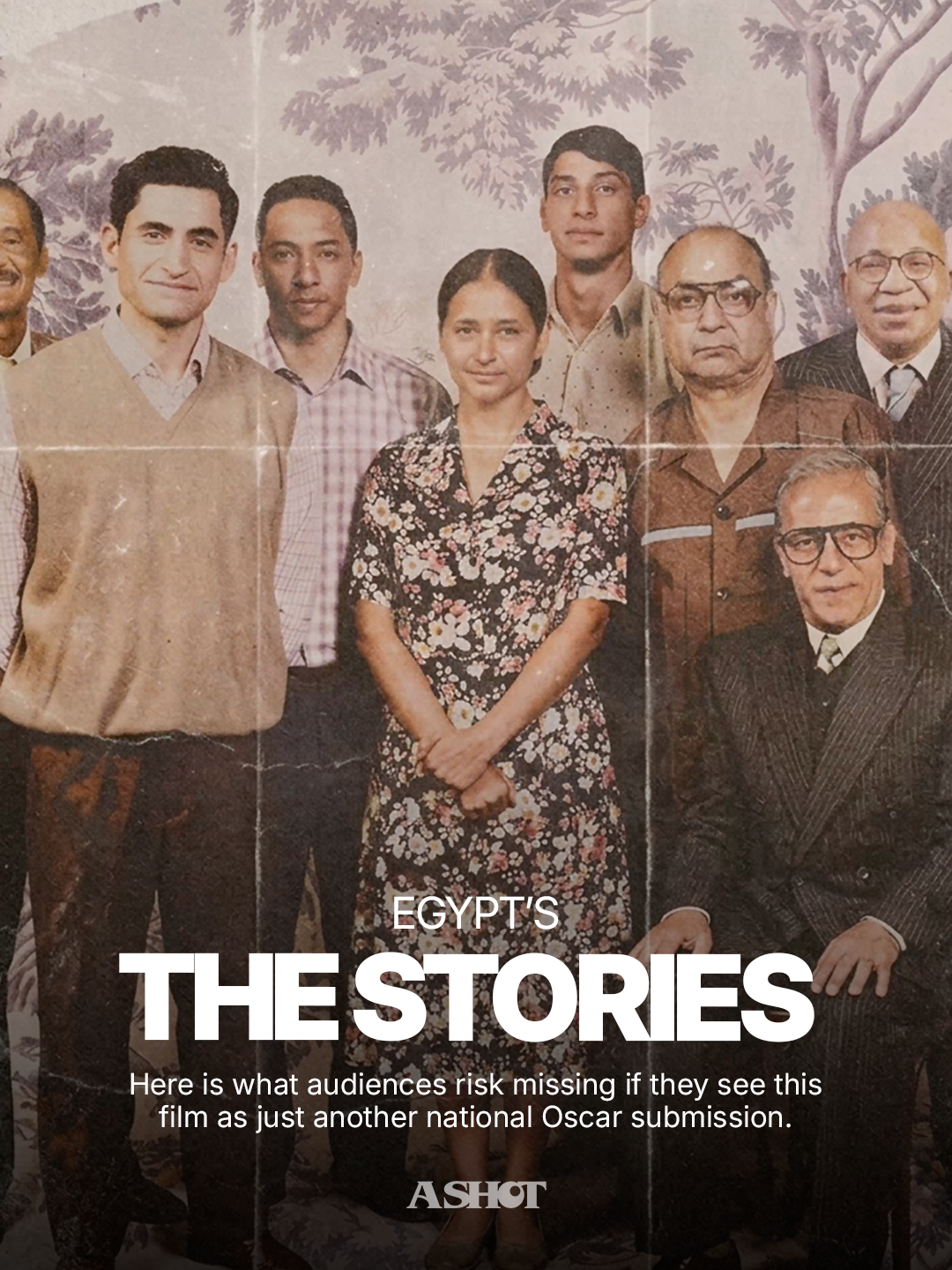
That overlaps between the monumental and the mundane is what makes The Stories such an unusual way of telling Egyptian history. Shawky tells history from the perspective of those living through it, following ordinary people as they try to get on with their lives while larger events reshape the world around them. The film begins in 1967 and follows an ordinary Cairo family across nearly two decades, with national events filtering into living rooms through television sets, radio broadcasts, street unrest and the consequences they leave behind.
Following an international festival run that took the film from Tallinn to the Red Sea and a Golden Tanit win at Carthage; The Stories now enters the Oscar race as Egypt’s official submission for Best International Feature Film. Its next hurdle comes on December 15, when the Academy announces the category’s shortlist, before the final Oscar nominations are revealed on January 21, 2027.
That designation inevitably asks the film to do something much larger than the modest lives at its centre: represent a country to an international audience. However, what makes The Stories worth paying attention to this awards season is the intimacy with which it captures Egypt, allowing decades of history to emerge through family anecdotes, ridiculous arguments, private disappointments and tiny victories that don’t make it into history books at all.
Early in The Stories, (precisely, the opening scene), Liz remembers watching a snail retreat into its shell when she touched it, then slowly emerge again. “It knew I wasn’t going to hurt it,” she recalls. “I was only watching. And I felt acknowledged.” What stays with her is not really the snail, but the strange urgency of recording the encounter at all: if she does not tell someone about it, did it really happen? It is the kind of tiny story that would ordinarily disappear. The Stories is full of them.
The film is partly built from Abu Bakr Shawky’s own family mythology. Like Liz and Ahmed, Shawky’s Austrian mother and Egyptian father first came to know each other through letters, beginning a relationship across Vienna and Cairo that would eventually bring two families together. Around that central story, Shawky gathers memories of parents, grandparents, aunts, uncles, neighbours and people who might otherwise survive only in somebody else’s recollection.
That gives the film its peculiar relationship with history. Its characters live through events that already have names, dates and places in textbooks, but Shawky seems equally interested in everything history has no reason to record. None of these moments changes Egypt, and that is exactly why they matter here.
Placing them side-by-side is like weaving a grand tapestry where a single stitch of daily life holds the exact same structural weight and visual gravity as the blazing, jagged threads of a historical battle. Official history can tell us that El Sadat was assassinated on October 6, 1981. A family story remembers that on the same day, a man found out his wife was pregnant and cried so hard that everyone around him misunderstood why. That is the history The Stories is interested in preserving: not an alternative to the events that shaped Egypt, but the millions of private lives that continued underneath them.
The Egypt at the heart of The Stories comes alive through the rhythms of regular life, from the glow of television sets, the noise of football matches spilling through living rooms, to cigarettes shared on balconies, songs bleeding into crowded streets and families talking over one another around the same table.
You hear it in Ahmed Adaweya’s “Zahma Ya Donia Zahma” spilling into a moment of grief, and in a family of Zamalek supporters convinced that perhaps, if everybody just sits in the correct place this time, their team might finally win. You see it in crowded living rooms, television advertisements promising that the next thing you buy might make you happier, and people shouting at each other to go home as trouble erupts outside. Even Liz, arriving from Austria, is not kept at the edge of this world for long. Before long, she is sitting among Egyptian women, talking about becoming a writer; later, when the streets descend into chaos and she is supposed to leave, she goes back out into them with Ahmed instead.
Shawky trusts these details to carry their own meaning. Zamalek, in particular, becomes something close to a family inheritance. The men watch, argue, rearrange themselves and lose; then they do it all over again. Their belief that the right seating arrangement might somehow change the result is ridiculous, but also strangely consistent with a film about people searching for tiny pockets of control while much larger forces dictate the shape of their lives. They cannot control wars, governments, careers or corruption, and they cannot, apparently, control Zamalek football matches either.
At one point, even the 1977 Bread Riots become entangled with football: national unrest arrives at the moment the family believes Zamalek might finally have a chance at the league. It is funny because the scales are so absurdly mismatched. It is also completely faithful to the way people experience history. A political crisis does not suspend the football match you were waiting for, the person you were grieving or the dinner you were supposed to have. They ingenuously become stories that happened on the same day.
That specificity also makes Liz’s place in the family more interesting. When her Austrian family arrives in Egypt, it produces one of the film’s simplest images of cultural difference: two fathers who cannot speak each other’s language sharing a cigarette on a balcony, eventually settling on the one word they both understand: “family.” Inside, their wives manage something similar, talking and crying together despite everything that should make communication difficult.
For all its roots in Egyptian soil, The Stories travels easily beyond it, carrying the quieter heartbeat of family life across oceans. You may never have cared whether Zamalek wins a match, but you can understand what it means to inherit a hope that belonged to someone before you and, somehow, find yourself carrying it too.
If history enters this family’s home through the television, there is one word the television would apparently prefer they never say: corruption. Ragheb, Ahmed’s father, learns this early. Appearing on television, he lets the word slip and is abruptly cut off. Years later, Liz manages almost exactly the same thing. By then she has written a book about her husband’s family, and when she is asked why Ahmed has still never performed the concert he has spent most of his life chasing, her answer comes down to one word: corruption, prompting the broadcast to cut away and recreating, decades later, the same panic around the same forbidden word.
It becomes one of The Stories’ funniest recurring jokes and one of its most revealing, as governments change, presidents come and go, and the same television presenter somehow remains, dutifully shepherding the family — and us — from one political era into another. That proximity to power takes on a more physical form through the presidential photographs that keep resurfacing across generations.
Ragheb treasures a photograph of himself with President Gamal Abdel Nasser, treating proximity to the president almost as an achievement in itself. Decades later, Ahmed finds another presidential photograph hanging in an office, this time belonging to Shams, the colleague who has received the promotion Ahmed believed would finally be his. Ahmed has spent years waiting to become head of department; Shams, meanwhile, has returned from abroad with the right connections, the right confidence and, crucially, a photograph with the president. If you had a picture with the president, perhaps things would have gone differently, the film jokes.
The photograph becomes a wonderfully ridiculous form of currency. It does not necessarily prove anything, but it suggests everything: access, recognition, importance, belonging somewhere near the machinery of power. When an enraged Ahmed later smashes one presidential image, another is never very far away. You can break the photograph; you cannot quite escape what it represents.
That becomes even more absurd after Liz’s television interview. Having publicly suggested that corruption is the reason Ahmed has never been allowed his concert, her comment creates a problem that apparently requires institutional proof to the contrary. Ahmed finally receives the opportunity he has been waiting for, partly so the institution can demonstrate that, actually, there is no corruption here at all. After years of being denied the thing he wants, merely naming the system that denied it helps produce the thing itself.
There is another kind of inheritance running through The Stories: the things women are told, the things they keep to themselves, and the things they eventually decide to write down. When Liz sits among the women of Ahmed’s family and tells them she wants to become a writer, the question that follows is almost immediate: what would she write about? Her mother, Liz answers — the same mother we already know she has a difficult relationship with. It is a small exchange, but one that subtly establishes what writing means in a film so preoccupied with memory. To write about your family is to preserve it, but it is also to expose it. Stories keep people alive; and can also tell the truth about them.
The film returns to that tension across generations with writings hidden underneath beds, and family histories carried privately until someone decides to put them into words. At one point comes the warning that if a writer enters a family, that family is finished — a joke that lands particularly well in a film whose very existence depends on somebody doing exactly that.
By the end of The Stories, Ahmed has spent what feels like a lifetime trying to play one concert. The ambition survives war, bureaucracy, family deaths, professional disappointment and the recurring possibility that the concert might simply never happen. When it finally does, even the victory arrives slightly sideways. Ahmed sits down at the piano and looks around for the audience he has imagined for years, only to realise that he is playing for a radio broadcast. He is finally being heard; the people listening just are not in the room. It would be a fittingly bittersweet conclusion on its own. Shawky, however, has another small miracle waiting. Zamalek are winning.
For a family that has spent years crowding around the television, rearranging themselves in desperate attempts to somehow influence the score, the victory feels almost as improbable as Ahmed reaching the piano. Two of the film’s longest-running disappointments suddenly break at once. Ahmed finally plays. Zamalek finally win. For once, the universe seems willing to cooperate.
These are not enormous victories, especially against everything the family has lived through. Nobody has defeated corruption, nor has anybody gained control over history. The dead remain dead, the careers that stalled remain altered by it, and the years lost waiting cannot be returned, but The Stories has never measured a life only by its biggest events. Why, then, should its victories need to be big?
There is one final joke left to complete the circle. After spending years watching photographs with presidents function as a strange shorthand for status and success, Ahmed finally gets one of his own. He finds himself participating in the very ritual he has spent years mocking. Having spent so long laughing at the idea that standing beside power could somehow validate a career, he is suddenly delighted to have the picture for himself, immediately turning to make sure everyone saw it happen. “Did you see me?” he asks.
He got the concert, Zamalek got the win and, perhaps most importantly, he got the picture. Later, Liz tries to settle the matter. Everything went well after all, she tells him. Ahmed cycles through the possibilities: yes. No. He does not know. But he does have that photograph. That photograph is destined for the most appropriate place imaginable: above the television. Official history and family mythology, finally hanging on the same wall. The joke has travelled from father to son.
For a film now being asked to carry Egypt into the Academy Awards, there is something fitting about that refusal to turn its own ending into a grand triumph. The Stories does not argue that ordinary people overcome history. Mostly, they survive long enough to collect a few victories inside it.
Remembering a family also means inheriting what came before you. Fairouz, played by Nelly Karim, speaks about her mother and grandmother not as uncomplicated sources of comfort, but as difficult women who were themselves shaped by difficult lives. What one generation survives can become the behaviour the next generation has to make sense of. A mother becomes a story told by her daughter; that daughter becomes a story told by someone else, which brings us back to Liz and the snail. If she had never told anyone about that tiny encounter, she wonders, would it have really happened?
The Stories never gives us a grand answer, it simply keeps telling. About a woman who wanted a new stove, a mother whose writing stayed underneath her bed, a brother who died, a photograph above a television. None would qualify as history in the conventional sense, but somebody remembered them, somebody repeated them, and later, somebody wrote them down. At the end, that is all a family history ever is: the stories that managed not to get lost.