

Zach Cregger Wants to Be Intimidated by His Next Movie
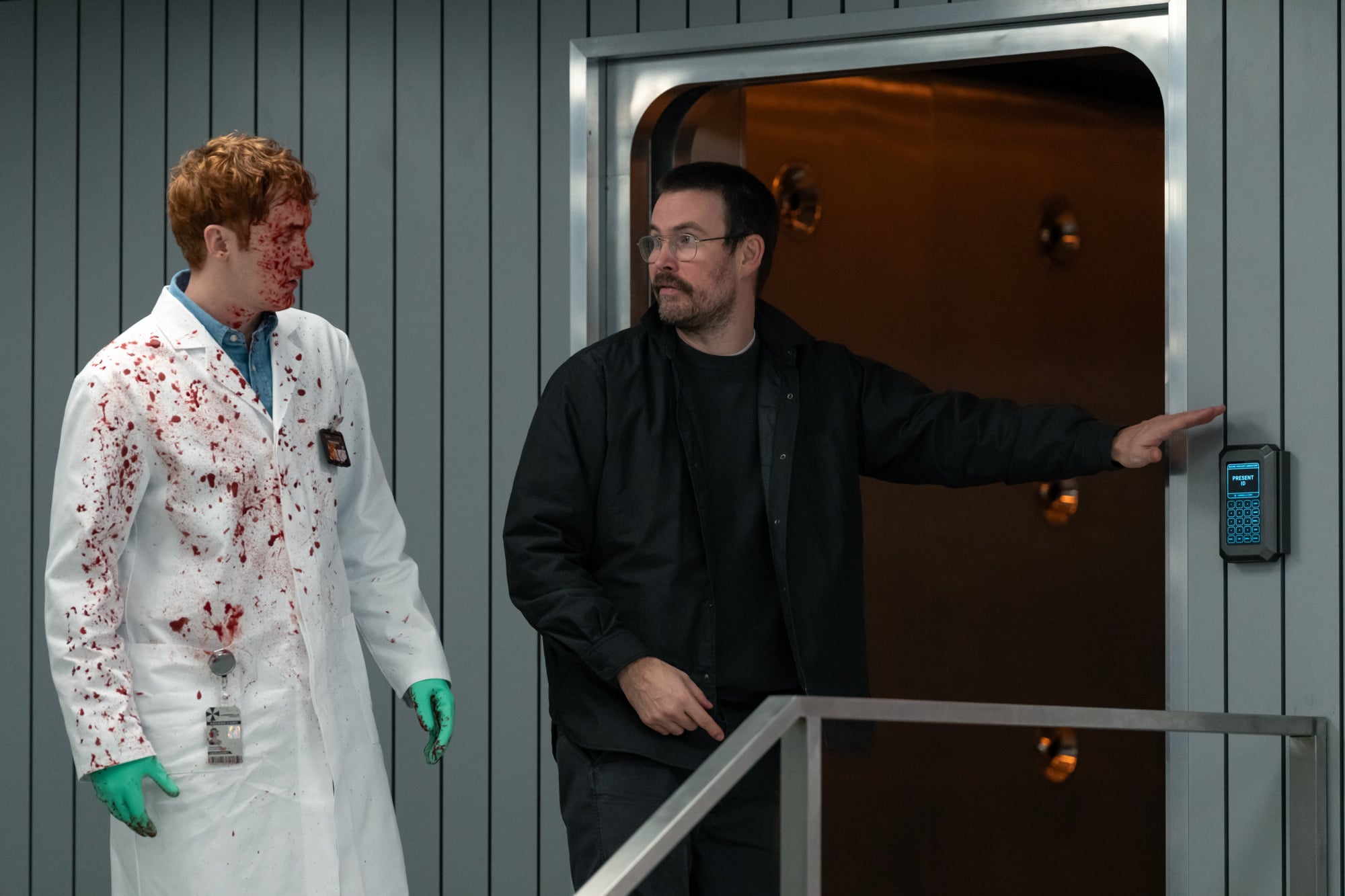
In the space of just a few years, Zach Cregger has gone from making one of the great horror surprises of the decade to becoming someone horror fans will show up for on name alone. Barbarian announced an exhilarating new voice with a near-sadistic understanding of audience expectations. Weapons proved it was anything but a fluke, expanding his canvas without sanding down any of the weirdness that made his first horror film so exciting. And with Resident Evil, Cregger has taken perhaps the biggest risk of his career so far, stepping into a world carrying nearly three decades of expectations and refusing to make the movie anyone assumed he would.
Filmmaking, however, was never supposed to be Cregger’s second act.
Long before The Whitest Kids U’ Know, his years as an actor or even his first feature behind the camera, 2009’s Miss March, this was always what he wanted to do.
“That’s what I wanted to do when I was a little kid,” Cregger says. “I feel like sometimes your six-year-old self is maybe your honest core or something like that. I have no idea what I’m talking about, but when I was a little kid, I wanted to do this. I wanted to make movies.”
“I loved art of all kinds.”
“I was in a band for a while and I did, obviously, live comedy, but this is what I always really wanted to be doing,” he continues. “I think I got diverted along the way at various times, but I feel very, very fortunate to have been able to, a little bit later in life than I was probably expecting, get where I was always hoping to get.”
Where he has ended up would have probably sounded fairly ridiculous to that six-year-old.
After Barbarian and Weapons, Cregger was handed one of the most recognisable horror properties in gaming. But rather than retell the story of Leon Kennedy, Jill Valentine, Claire Redfield or any of the other characters fans have spent decades with, he and co-writer Shay Hatten built an entirely new story inside the universe.
Resident Evil follows Bryan (Austin Abrams), a medical courier whose routine job sends him toward Raccoon City on exactly the wrong night. What follows is essentially one prolonged nightmare, moving Bryan through a series of increasingly horrifying environments as a man with almost no useful survival skills is asked to do little more than keep moving forward.
It is also exactly the kind of choice that makes Cregger such an interesting filmmaker. Given access to almost three decades of characters, mythology and instantly recognisable iconography, he chose to follow the guy who, in almost any of the games, would probably be running past you somewhere in the background.
That decision was never going to please everyone.
Cregger knew while writing the film that he was making something markedly different from what a large portion of the fanbase expected. At first, that was part of the appeal.
“I think as I was writing it, I was aware that I was doing a very different thing, and I think that was a thrill,” he says. “That thrill lasted only during the script writing.”
Once production was over and the film moved closer to release, the conversation surrounding it began to change.
“I realised that all of that expectation, that cultural expectation, was actually really unpleasant for me,” he admits. “Because it wasn’t about the movie. It was this giant conversation about all these things that really weren’t about the movie itself. And so that was something I don’t think I had appreciated when I started on that ride.”
Months before anybody had seen the finished film, every deviation was already being litigated. Why was there snow? Why did Bryan have a modern phone? Why wasn’t this simply another version of Resident Evil 2?
Cregger’s answer was essentially that he wanted to make the movie he wanted to make.
That gamble has paid off. Resident Evil currently holds a 96% critics score on Rotten Tomatoes, making it the first live-action film in the franchise to earn a Certified Fresh rating, while audiences have similarly embraced Cregger’s decision to translate the experience of playing the games rather than simply reproduce their plots.
With Henchman, that means remaining with a “little worker bee” while something enormous happens around him.
“We’ve seen so many Batman stories, but to see it from just a bystander who’s on the edge of everything, I don’t know, I’m so fascinated by that.”
Cregger may keep widening the canvas around his characters, but the problem directly in front of them tends to remain incredibly simple.
Get out of the basement.
Find the missing children.
Make the delivery.
Survive the night.
That simplicity becomes especially important in Resident Evil, because Cregger is trying to translate something film can never literally reproduce: the feeling that the terrible decision being made on screen is somehow yours.
Video games implicate the player in every mistake. A movie cannot. Cregger’s solution was to look less at the mechanics of the games than at their rhythm.
“The games have this really compelling visual language,” he says. “By framing it visually the way I did, we are just so locked in with the character’s experience. I hope that’s the case. That was the goal anyways.”
More importantly, he understood that playing Resident Evil isn’t just shooting zombies and desperately searching for ammunition.
A lot of it is walking.
“The games really celebrate the journey,” Cregger explains. “There’s so much just walking through a room silently in these games. I feel like you’re just sitting with this character, and you’re with them when shit’s popping off, but you’re also with them when they’re just walking.”
There is a sequence in the film where Bryan crosses a snowy field, climbs over a fence and simply keeps going.
Nothing attacks him. There is no enormous set piece waiting halfway across. Cregger still considers it essential.
“I feel like that is just as important as when he’s shooting something in the head,” he says. “That’s my theory anyways.”
It’s an unusually confident choice for a studio horror movie based on a video game, treating a man silently trudging through snow as seriously as the monster waiting for him at the other end. But that patience may be where Cregger gets closest to the games themselves. Resident Evil has always been as much about the dread between encounters as the encounters.
By the time Resident Evil was officially greenlit, casting was essentially a formality.
Cregger remembers speaking with Sony Pictures chief Tom Rothman and immediately making one thing clear.
“I was like, ‘Just so you know, thank you for greenlighting the movie, it’s gonna be Austin.’ And he was like, ‘Yeah, great.’ So it was from the beginning.”
It’s easy to understand why.
Abrams is especially good at making Bryan feel like a completely ordinary person dropped into a situation he is wildly unprepared for. There’s something very funny about how overwhelmed he is by everything happening around him, but he never plays that panic for laughs. It keeps Bryan grounded even as the film gets bigger and more intense.
Cregger is reluctant to take too much credit.
“A lot of that is also just Austin is a phenomenal actor,” he says. “I can only take so much credit.”
Bryan’s very bad night also arrives while something much more ordinary is already weighing on him.
Early in the film, his girlfriend tells him she may be pregnant. He barely has time to process the possibility of becoming a father before everything around him becomes violently, spectacularly uncontrollable. Suddenly, a character already unsure whether he is prepared for one enormous responsibility is being handed another every few minutes.
For Cregger, that personal conflict was essential.
“You always want to put something from your life into your work to make it mean something to you,” he says. “I feel like if it’s personal, then I can really lock in.”
“I think every adult probably has moments where they are reckoning with, ‘Should I? Shouldn’t I?’ in regards to parenthood,” he adds. “And I understand that.”
If Bryan keeps Resident Evil tethered to something recognisably human, the creatures surrounding him give Cregger permission to go in exactly the opposite direction.
His monsters have always been particularly memorable, but the process behind them is not nearly as straightforward as “make it disgusting.”
LOS ANGELES, CALIFORNIA - SEPTEMBER 15: Zach Cregger speaks on stage at the World Premiere of Constantin Film and TriStar Pictures RESIDENT EVIL at The United Theater on Broadway on September 15, 2026 in Los Angeles, California. (Photo by Stewart Cook/Sony Pictures Via Getty Images)
For Barbarian, the Mother began with a drawing of Grendel’s mother from an illustrated edition of Beowulf Cregger owned.
“We were working on that look, which was really modelled off of an illustrated book of Beowulf that I had,” he says. “There was a drawing of Grendel’s mother, and so I was really just trying to replicate that drawing.”
The first attempt was relatively restrained.
“I thought it was pretty good. It was very subtle stuff.”
One New Regency executive disagreed.
“She was like, ‘I just don’t think you’ve gone far enough with the face. It doesn’t look that upsetting.’ And I realised that she was exactly right.”
Cregger and the effects team went back to work.
“We really fucked this face up a lot more,” he laughs. “I was glad that we did.”
The funny thing is that the grotesqueness of the Mother ultimately has to serve a very human purpose.
Barbarian begins with Tess (Georgina Campbell) arriving at a Detroit rental home only to discover that it has somehow been double-booked with Keith (Bill Skarsgård), a stranger who initially seems like he could be the danger waiting for her. What she eventually finds beneath the house is something far worse: a sprawling network of tunnels, the Mother (Matthew Patrick Davis), and the horrifying history of Frank (Richard Brake), the man responsible for what happened there. Justin Long later enters the story as AJ, the owner of the house, whose arrival shifts the film in an entirely different direction.
The film spends much of its runtime constantly shifting the object of our fear. First Keith feels dangerous. Then the Mother does. Eventually, we understand that the real horror has always been Frank, and by the end, the creature we were originally conditioned to recoil from becomes one of the story’s greatest victims.
“You see her as a victim. You see the humanity in her. You see that she’s not the title character,” Cregger says. “Frank and arguably Justin Long are the barbarian, right? And the Mother is just a casualty of this.”
That need for humanity kept pulling him toward restraint.
Resident Evil demanded almost the opposite.
“This is a crazy video game thing where you’ve got to kind of swing for the fences,” he says. “Having somebody with tentacles shooting out of their neck hole, I’m not trying to retain their humanity so much.”
Cregger has previously called The Flood the screenplay he is most proud of, but his description of it now is a little more revealing.
“I think it’s my most human story,” he says. “It’s my weirdest movie. It is scary, I think, but it’s also structurally bizarre, but not in the way that Weapons and Barbarian are, in a new way that, to me, I’m the most excited about.”
He also has absolutely no idea how he is going to pull some of it off.
“There’s a lot of technical challenges in it that I have no idea how I’m going to pull off, but I’m excited to try,” he says. “And the ending is like my favourite thing.”
That uncertainty appears to be exactly what Cregger is looking for.
“You always want to be pushing yourself. You never want to feel like you’re going to make something that you are certain you’re going to nail.”
“So I am nervous about it,” he continues. “But I think that is just a sign that I’m on the right track. The fact that I’m kind of intimidated by it, I think, is a healthy thing.”
His attitude heading into Resident Evil had been very different.
“I was thinking when I was making Resident Evil, I wasn’t really pushing myself,” he says. “I was just kind of like, I can shoot these crazy scenes, and I can make it kind of funny and do this.”
His expectation?
“This will just be like a fun kind of spa day for me as a filmmaker.”
It was not.
“So who knows what I’m in store for on this one, where I feel already like this is going to be the hardest movie ever,” he says. “But I think it might be the one I’m the most proud of when all is said and done. We’ll see.”
Whatever comes after The Flood is considerably less certain. Cregger jokes earlier in our conversation that he doesn’t even know whether he’ll make another movie or “do something else” with his life. For now, though, he seems happy to still be inside horror at a moment when the genre feels particularly open to people doing things nobody quite expects.
He points to Kane Parsons’ Backrooms and Curry Barker’s Obsession, two very different 2026 horror films from young filmmakers who built their audiences online before making the jump to bigger features. Parsons was just 20 when Backrooms arrived in theaters, while Barker’s Obsession followed his breakout micro-budget work online. Both films became significant genre successes this year.