

Thank God for Netflix’s The Body
Horny, hysterical, deeply unserious and surprisingly smart, Netflix’s The Body is everything teen television has been missing.
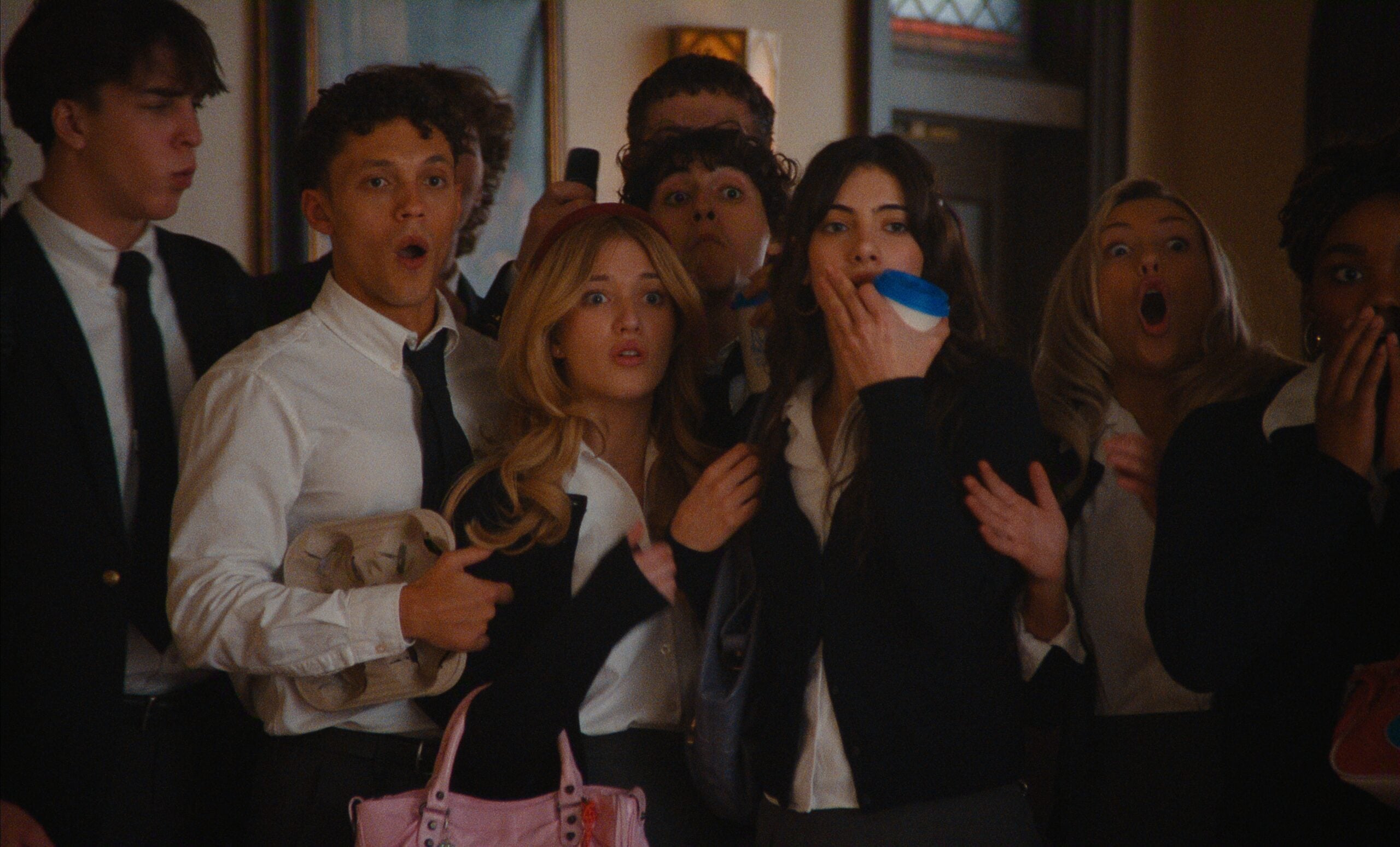
There are few things more alarming to adults than a group of teenage girls who appear to have lost their minds. One girl screaming is a problem, but ten girls screaming? It’s an epidemic. Add a Catholic school, a suspicious initiation ritual and a few claims of supernatural visions, and suddenly everyone is looking for the devil.
Horror has understood this for a long time. Teenage girls have an extraordinary capacity to frighten people, especially when they begin behaving in ways that cannot be easily explained, disciplined or dismissed. Their emotions are excessive, their friendships are obsessive, their bodies are changing, and their desires are suspect. When those things become too difficult for the adults around them to comprehend, the supernatural offers a remarkably convenient explanation.
Something must have gotten into them.
Netflix’s The Body, created by Quinn Shephard, takes that suspicion and runs with it. Set in the early 2000s, the series follows the Lions, a Catholic school dance squad whose initiation ritual goes spectacularly wrong. The series spirals into prophetic visions, paranoia and hysteria, as the girls become more and more convinced that something extraordinary is happening to them.
At the centre are Anya Butler (Kristina Bogic) and Elise Zakaria (Sara Boustany), two girls whose relationship becomes the emotional fault line of the series. Anya is the Lions’ captain, a gifted dancer and seemingly effortless queen bee whose carefully maintained perfection conceals a growing desperation to suppress her sexuality. Elise, her loud, abrasive and fiercely loyal best friend, is the girl everyone is slightly afraid of, even as she nurses feelings for Anya that she cannot bring herself to confess.
Around them is a wonderfully combustible collection of personalities. There’s Grace Franklin (Sofia Wylie), the charismatic, devout Catholic whose influence makes her both magnetic and dangerous; Lisbeth Anderson (Geena Meszaros), the observant outsider desperate to secure her place among the girls; Maddie Delaney (Shirley Chen), the sweet, eager-to-please friend whose inability to keep a secret proves particularly unfortunate in a group built around them, and Katie (Bella Neuspiel), the sarcastic, perpetually unimpressed voice of reason who seems to spend much of the series wondering why everyone around her is losing their minds, even if she’s not quite as unbothered as she’d like everyone to believe.
Together, they form the Lions, a dance squad with its own hierarchy, rituals, loyalties and unspoken commandments. The question, however, is not simply whether something supernatural has taken hold. It’s why everyone is so prepared to believe that it has. After all, the history of female hysteria is, in many ways, a history of people trying to explain women to themselves.
Historically, hysteria has been treated as something of a female affliction, a diagnosis through which women’s emotions, desires and behaviours could be interpreted as symptoms of something fundamentally wrong with them. While the medical understanding of hysteria has changed considerably, the association between adolescent girls and psychological disturbances has not entirely disappeared.
Reported outbreaks of mass psychogenic illness have often involved groups of school-aged girls, whose shared physical symptoms or unusual behavior can spread through tightly connected social environments without an identifiable organic cause. Such episodes are real experiences of distress, even when their symptoms cannot be attributed to a conventional disease process. However, the cultural fascination surrounding them frequently has less to do with the girls’ suffering than with the spectacle of their apparent loss of control.
The show’s title offers another way into this tension. The Body is an almost absurdly perfect name for a story about Catholic schoolgirls. Catholicism is a religion deeply concerned with the physical. Flesh and blood, purity and sacrifice, virginity and temptation, the crucified body and the body of Christ. Its rituals continually transform bodily experiences into spiritual meaning. Desire can become sin, whereas suffering can become devotion. The body is something through which faith is expressed, but also something whose impulses must be governed.
Now place a group of teenage girls inside that framework. Their bodies are already undergoing transformations they cannot entirely control. They are discovering sex, attraction, queerness and the peculiar humiliation of being physically present in a world that seems determined to have an opinion about them. Their bodies are simultaneously sources of pleasure, anxiety, shame and social currency.
Grace’s storyline takes this relationship between the body and religious belief to its most unsettling extreme. After falling into a coma, Grace becomes the unlikely centre of a growing religious phenomenon, with people visiting her bedside in the belief that she possesses miraculous healing powers. Her unconscious body becomes an object of devotion, transformed from that of an ordinary teenage girl into something approaching a living relic. People come seeking miracles, projecting their hopes, fears and faith onto someone who cannot speak for herself, much less confirm the extraordinary abilities being attributed to her.
It's disturbing how the ease with which Grace’s suffering becomes evidence of holiness. Her body is no longer understood simply as a body in need of care, but as a vessel through which something divine might be working. The less she is able to participate in the narrative surrounding her, the more confidently others seem to construct it. In a series preoccupied with girls struggling to control their own bodies and identities, Grace becomes the most extreme example of what happens when that control is taken away entirely. She doesn’t even have to be conscious for the world to decide what her body means.
And then, of course, the girls are dancers. Long before anything paranoia enters the picture, the Lions have been trained to control their bodies with extraordinary precision. Dance demands repetition, synchronisation, discipline and the ability to make difficult physical movements appear effortless. Every gesture is rehearsed; every mistake visible. Their bodies must move together, respond to instruction and perform a particular image of femininity.
Catholic school imposes one system of bodily discipline. Dance imposes another. Girlhood, with its endless instructions about how to look, move, desire and behave, imposes a third. Possession, whether real or imagined, threatens to undo all three. Possession, whether real or imagined, threatens to undo the systems of control imposed upon the girls. But Anya and Elise suggest another possibility entirely: that losing control might not always be something to fear. Sometimes, it might be the closest thing to freedom.
For Anya and Elise, queerness complicates all three. Their relationship is arguably the most compelling expression of the show’s obsession with repression. Anya, the seemingly perfect captain, is so determined to maintain the image expected of her that acknowledging her sexuality feels like an admission of failure. Elise, meanwhile, has made something of a personality out of being unapologetically herself, yet even she struggles to articulate the one thing that matters most: her feelings for Anya. For all their intimacy, these are two girls who have become remarkably skilled at avoiding the truth about each other.
This makes their improvised contemporary dance routine during Regionals all the more extraordinary. Following a falling-out, the two find their way back to each other not through some grand romantic confession, but through movement. It turns into something closer to a conversation, an unspoken reconciliation unfolding in front of an audience that has no idea what it is actually witnessing. For once, their bodies are communicating something neither girl has managed to put into words.
There’s a delicious irony in watching two girls who have spent so much time concealing their feelings express them through the very discipline that has taught them to control every movement. Dance, ordinarily another mechanism of perfection and conformity, becomes their moment of freedom. The choreography is improvised, their connection instinctive, and the emotional honesty almost embarrassingly visible. In a world where Anya cannot comfortably admit whom she desires, she can at least dance with her.
Their queerness isn’t presented as some extraordinary revelation requiring supernatural explanation. It’s something painfully ordinary: two teenage girls trying to work out what they mean to each other, and discovering that their bodies have arrived at an understanding long before their words have caught up.
The disciplined body becomes unpredictable. The synchronised body moves according to impulses nobody can explain. The girl who has spent her life being told how to behave suddenly appears incapable of behaving at all. The reversal is deliciously subversive. In this world, girls’ bodies are constantly being watched and regulated, and the possibility that those bodies might become uncontrollable is both the central horror and a strange kind of liberation.
But The Body is not only interested in the institutions governing the girls from above. It is equally fascinated by the institution they have created among themselves. Teenage friendship, particularly the kind depicted in early-2000s cinema, can begin to resemble a religion of its own.
There are rituals, codes, confessions, hierarchies, punishments and acts of devotion. There are people whose approval matters more than anyone else’s, secrets that cannot be repeated and rules that everyone understands without anyone having to explain them. Belonging is sacred. Exclusion can feel like excommunication. Just ask Lisbeth.
The Body places these tensions in the early 2000s, a period whose cultural attitudes toward sexuality were very different from those of the present. Queer teenagers certainly had communities, language and ways of understanding themselves, but access to those resources was uneven, particularly within institutions that treated heterosexuality as the unquestioned norm.
A Catholic schoolgirl might therefore find herself surrounded by an elaborate vocabulary for what she should not desire, while struggling to find an equally accessible language for what she actually feels. The series makes that conflict part of its larger atmosphere of uncertainty. Its girls are not simply frightened of supernatural forces. Anya, for example, is frightened of being discovered, of wanting the wrong person, of failing to perform the version of herself that her social world demands.
This then creates one of the show’s most revealing parallels. Some of the girls begin claiming supernatural experiences they may not actually be having. Meanwhile, a girl concealing her queerness may find herself performing heterosexual desires she does not feel. One girl says she is seeing things, and suddenly everyone else begins seeing things too. Everyone says they like boys, and the girl who doesn’t understands exactly what she is supposed to say. In both cases, belonging depends on recognising what the group expects and deciding whether to reproduce it.
This is not to suggest that queer identity and collective hysteria are equivalent. Rather, the series places two very different experiences within the same social machinery: the pressure to make one’s private reality conform to a public consensus.That machinery is especially powerful in adolescence, when identity can feel less like something one possesses than something constantly being negotiated with everyone around them.
Who says something first matters. Who gets believed matters. Who is allowed to be strange, desirable, sinful or correct matters When Lisbeth lets out an enthusiastic roar during the dance audition, she’s met with uncomfortable side-eyes, her attempt at fitting in only making her appear more out of place. But when Anya or Elise behave outrageously, their confidence is practically a personality trait. What makes Lisbeth embarrassing makes the popular girls entertaining. The girl at the top of a social hierarchy does not simply decide what is fashionable. She can influence what everyone beneath her understands to be real.
The Body - Season 1. (L to R) Kyra Pierce as Bailey, Bella Neuspiel as Katie, Sara Boustany as Elise, Sarah Abbot as Olivia, Geena Meszaros as Lisbeth, Shirley Chen as Maddie, Emily Roman as Claire, Phallon Pierce as Brit in episode 101 of The Body. Cr. Courtesy of Netflix © 2026
The Body understands how quickly that process can become self-sustaining. One girl becomes frightened. Another sees her fear and begins to panic. The second girl’s reaction convinces the first that her original fear was justified. Soon, the group is no longer responding to a single event but to the accumulating evidence of its own reactions. Fear becomes contagious because everyone is watching everyone else.
There is a cruel irony in the fact that the girls are trained dancers. Their greatest collective skill is the ability to move together, to anticipate one another’s movements and respond almost instinctively to a shared rhythm. The same synchronisation that makes them a successful dance squad also makes their hysteria possible. They have spent weeks learning how to move as one body. Now they are learning how to believe as one.
Yet the series is too funny, too crude and too interested in the absurdities of teenage life to treat all this as a straightforward tragedy. Its girls are horny, sarcastic, occasionally cruel and frequently ridiculous. They make terrible decisions, say inappropriate things (“I masturbate to Daddy Franklin!”, followed by “Yeah, we all do!”) and become invested in dramas that seem enormous to them and incomprehensible to everyone else.
For much of horror’s history, the teenage girl has been made to carry an almost impossible symbolic burden. She is innocence threatened by corruption, sexuality punished by violence, purity endangered by desire or the vulnerable vessel through which evil enters the world.
What she is less frequently allowed to be is simply a person who is funny, selfish, frightened, horny, confused and occasionally wrong. The Body gives its girls room to be all those things at once. Their queerness does not make them uniquely virtuous. Their friendships are not always healthy. Their religious environment is neither the sole explanation for their behaviour nor an incidental backdrop. Thus, the series allows these contradictions to coexist.
The girls are subject to systems of control, but they also reproduce those systems among themselves. They are frightened of judgment, yet constantly judge one another. They resist authority while creating their own hierarchies. They want freedom, but they also desperately want to belong. That just might be the most recognisable thing about them.Adolescence is, among other things, an extended negotiation between the desire to become oneself and the fear of becoming someone nobody else will accept.
The parallels between friendship and religion become almost comically literal when the Lions begin chanting to the devil, offering Grace as a sacrifice in exchange for a place at regionals. It’s a conflict of teenage ambition and religious imagery: a group of Catholic schoolgirls invoking dark forces not for eternal life, unimaginable power or forbidden knowledge, but for the chance to win a dance competition. Beneath the absurdity is something revealing about the girls’ priorities. They have been raised to believe in devotion, sacrifice and the possibility of divine intervention, and have simply redirected that faith towards the thing that matters most in their immediate universe: the Lions.