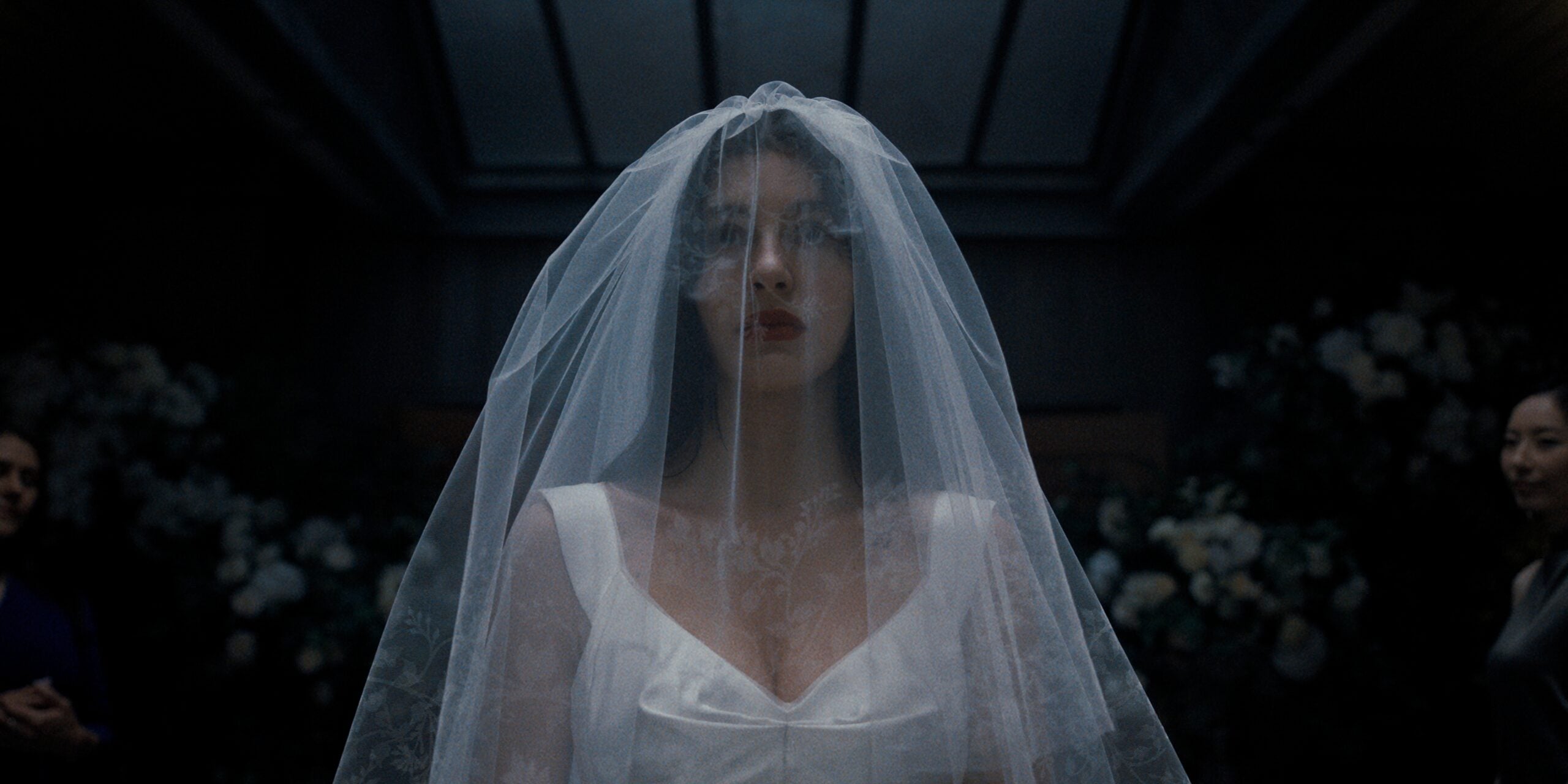
It’s a nod to the audience that while the stakes are life-and-death, the absurdity of wedding-season social graces isn't lost on the creators. It underscores the central tension: Rachel is hyper-aware of the danger, yet she remains tethered to the ritual, carving out her own dark space within a tradition that seems determined to swallow her whole.
Technically, the series excels at restless tension. The soundscape is claustrophobic, utilizing creaking floorboards and POV shots to ensure the viewer never feels like a passive observer. By the time the distorted glitches and warning-yellow lighting take over the screen, the show has successfully shifted the central question from "What is happening?" to "Why isn’t she leaving?"
Drawing from Carrie’s raw, almost carnal take on becoming a woman and Rosemary’s Baby’s suffocating paranoia around motherhood, Something Very Bad Is Going to Happen positions itself as the missing piece—a horror story about becoming a wife. There are also traces of films like The Celebration, Martyrs, Barbarian and television series Servant.
There are moments where the pacing falters, particularly in the early episodes, where the narrative lingers a bit too long in its ambiguity. But once the pieces begin to click—especially from episode four onward—the series sharpens into something far more cohesive and unsettling. The tone leans into a slow, under-the-skin dread rather than jump scares. For much of the first half, the threat feels external—until the midpoint reveals something far more supernatural at play
https://youtu.be/vMc_pWm7G7o?si=us7sRye3hd9WRdSI
Halfway through, the show drops its biggest treat: Victoria Pedretti as Rachel’s mother, Alexandra. She is predictably brilliant and unpredictably terrifying, bleeding from every pore as she anchors the show’s shift into pure body horror. As she stares directly into the lens—blood weeping from her eyes and nose—she breaks the fourth wall to implicate the viewer in the family's rot. Directed with haunting precision by Axelle Carolyn, the episode is the series’ crowning achievement. It is the moment the narrative bow is pulled tight, revealing a generational tapestry of blood and bargains.
This dread culminates in the show's most harrowing sequence: her husband Jay’s desperate, mid-climax delivery or ‘rescue’ of the baby. The sound design is unflinching—the wet, rhythmic snap of skin and muscle as he cuts into Alexandra—but the true horror is psychological. Jay’s wailing apologies, his insistence that he’s sorry, so sorry, even as he cuts and dices into her. It is the ultimate literalization of the wedding contract: a life for a life, all in the name of a legacy that refuses to die.
The revelation that the Sorry Man—the spectral figure of Jules’ nightmares—is actually her father is an unexpected pivot. By witnessing her own birth through Jules’ eyes, Rachel (and the audience) finally understands the "debt" she was born into. The curse is no longer an abstract fear; it is a literal inheritance, punctuated by a father who stabs his own daughter to "even the scales" of a dark, cosmic ledger.
At the heart of the horror is a Faustian bargain with Death itself. The show’s mythology posits a terrifying ultimatum: the curse only breaks if you truly believe you’ve found your soulmate—or you pay Death what is owed. This debt has been a silent protagonist throughout the season; we often see through Death's cold, predatory POV as he stalks the family. Death leaves cheeky little mementos—a doll’s red heel, a taunting token from the custard shop—reminding Rachel that she cannot escape. The mythology of the soulmate is a generational weight that robs Rachel of her agency.