Picture her: a red-lipped girl on a train going nowhere. No makeup otherwise. Skinny jeans with a slight flare, and eyes still stinging red from crying. A handsome stranger sits beside her; they kiss, and then—before the credits can even roll—she leaves first.
For the artist, these in-between states are where the truth lives. “Life doesn’t resolve itself neatly — emotions don’t either,” the artist reveals. “I’m not interested in tying things up with a bow. I’m interested in the moment before the decision, before the goodbye, before the clarity.” To her, that emotional suspension feels more honest to me than a clean ending.
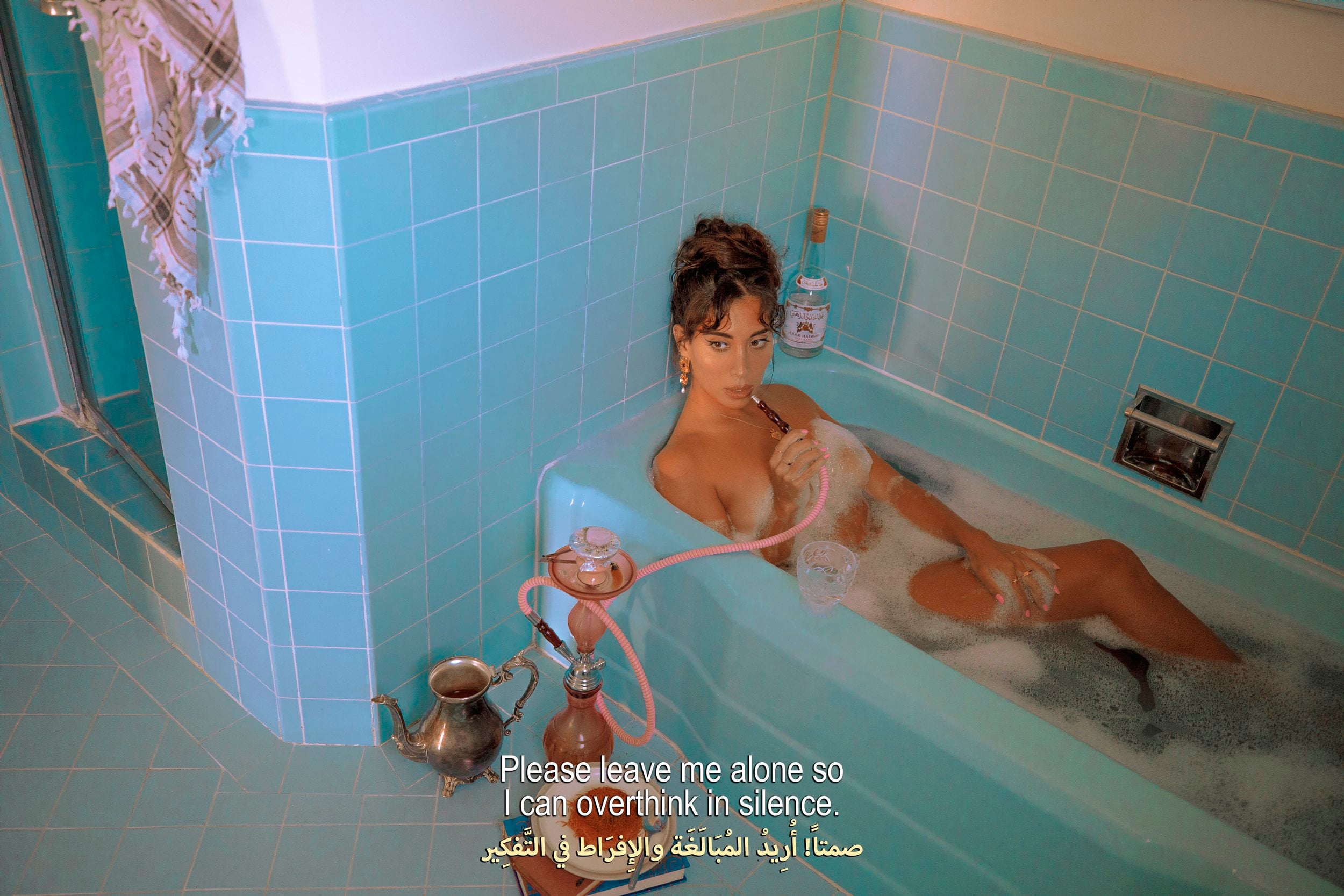
“When I actively choose to make a series,” she tells A Shot, “it’s the only way I know how to process my emotions. The spiraling, the one-liners, the dialogue — it’s happening while I’m trying to create scenarios where I feel safe.” Whether she is decoding the friction of attachment theory in Fool Me Twice, or dismantling the shadow of cultural silence in her Arab-centric series 3ieb! (Shame On Me!), Bahbah’s work is a cathartic spiral made safe.
“Sometimes I’ll write hundreds of subtitles,” she shares. “It’s a natural instinct for me to want to alchemize pain into something visual, healing through grief.” Even as she moves into long-form filmmaking with her modern-day fairytale Untangled and her expansive, 400-page retrospective book Dear Love, her mission remains the same: alchemizing private grief into a public liberation.
https://youtu.be/h3a7UhTxYRg?si=S9mdHcPjzoqzBkZ-
Her latest venture, the hybrid series Can I Come In?, takes this a step further, inviting others to step into custom-built worlds where they can finally release the stories they’ve never told. “With Can I Come In?, that was new for me. I had mastered doing this for myself. That series was me saying, ‘Let me create these worlds for you. Let me help you express yourself.’” In 2023, she put her life’s work into the 400-page Dear Love, a luxury fine-art book that bypassed the publishing machine and moved over 15,000 copies purely on the strength of her own community.
By splashing our most hushed, late-night thoughts across saturated, filmic frames, Bahbah created a visual lingo for the oversharer. But as these private confessions reach millions, they cease to be just art. Now, her work sits at a tense crossroads where her personal purging meets the messy politics of public ownership. “I shoot it, I release it — and once it’s out there, it’s no longer mine,” Bahbah says. “The process belongs to me. The work belongs to the world.”