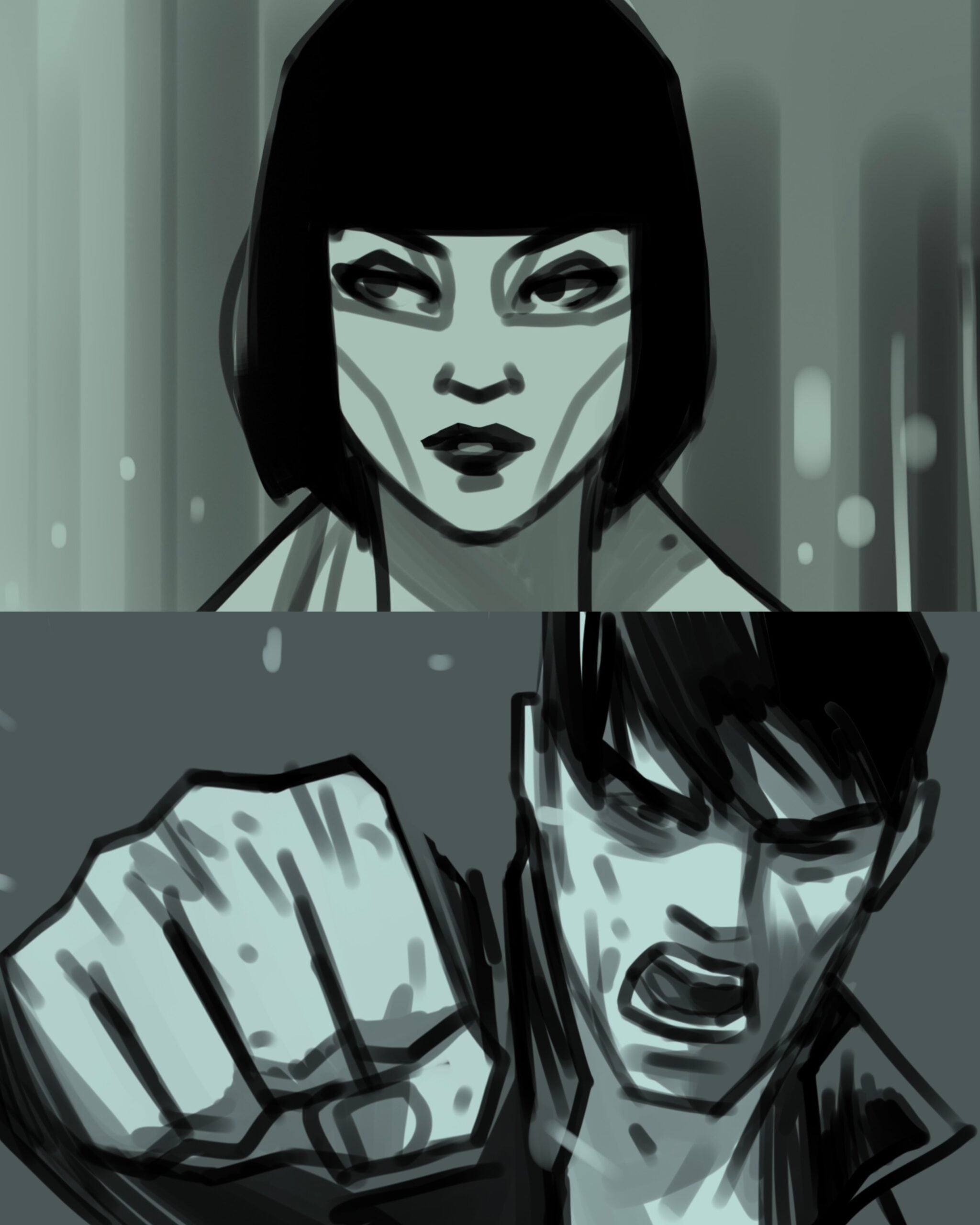
The storyboards were displayed in the production room so that the crew could follow the film’s structure. Refn supplemented them with reference images and what he calls “sensibility images,” allowing collaborators to understand not only the intended composition but the feeling he was trying to produce. “That led to more and more collaboration, because now the whole crew could really see the film,” he says. “They could see what it was all supposed to turn into.”
There is a useful tension in the method. Her Private Hell is deliberately dreamlike and emotionally excessive, but its production required unusual precision. The private vision had to become legible to an entire crew. Refn does not suggest that storyboarding will now define his process. His next project, he says, will be approached completely differently, but for this film it gave physical order to a world governed by unstable emotions. This idea of controlled chaos is a theme that continues to echo.
The film’s musical identity developed in a more spontaneous way. Refn initially assumed he would use an electronic score, as he had on many of his previous projects. During production, however, he found himself moving away from that idea without immediately understanding why. “I was leaning away from it more and more, and I didn’t know why I was suddenly so hesitant,” he says, “until I realised it’s because I wanted to make an opera. I just didn’t know it.”
Once he understood the film as an opera, its seemingly incompatible elements began to make sense together. Elle’s father leaves her and marries her former lover, who becomes her stepmother. Elle imagines an alter ego in Private K, who descends into hell. The relationships are heightened, painful and, as Refn puts it, “very operatic in grandiose ways.”
“There’s a lot of drama, a lot of melodrama and a little bit of camp,” he says. “The movie had to have everything I desired- from horror to sci-fi to action, fantasy, melodrama, kitsch, camp, sex, violence and color.”
The challenge and therefore goal was finding something that could hold all of those together, allowing them all to exist in harmony. This is where the operatic element enters. When watching the film, the score takes you by surprise only to shepherd you through the maze that is Her Private Hell. It warms you to the cold characters, adds a bit of oomph to otherwise unhurried scenes, and ultimately delivers a feeling of transcendence, or maybe even descendance. The answer to Refn’s needs was music, although he had arrived at it in reverse. In a sort of Frankenstein twist, Refn had already built the body of the film, and needed someone to get the blood flowing.
Refn went to Italy in search of one of the composers he associated with the tradition he wanted. “All the composers that you and I would probably refer to are dead. The only one alive was Pino Donaggio, and he was in his mid-eighties.” Donaggio, whose long career includes collaborations with Brian De Palma and scores for films including Carrie, Dressed to Kill and Blow Out, had written music for hundreds of films. Refn contacted him with a fairly direct proposition: “Do you want to write an opera?”
“The man has scored over 300 movies, so I don’t think anything was scary to him,” Refn says. “But it was scary to me.” Refn understood that the score would either unite the film’s many competing elements or expose how precariously they had been assembled. He remembers explaining the pressure to Donaggio in anatomical terms.
“You’re the most important person on this movie right now,” he told him, “Because you’re going to take this entire house of cards that I’ve built. There’s a heart in there somewhere, and I know where it is. You’re going to have to provide the blood. Because if all these veins running through the film from the heart are empty, the house of cards is going to fall apart.”