

Kristina Bogic Is an Anya Apologist & Proud of It
She lies, makes terrible decisions, and has enough Catholic guilt to last a lifetime, but Kristina is standing by her girl Anya.
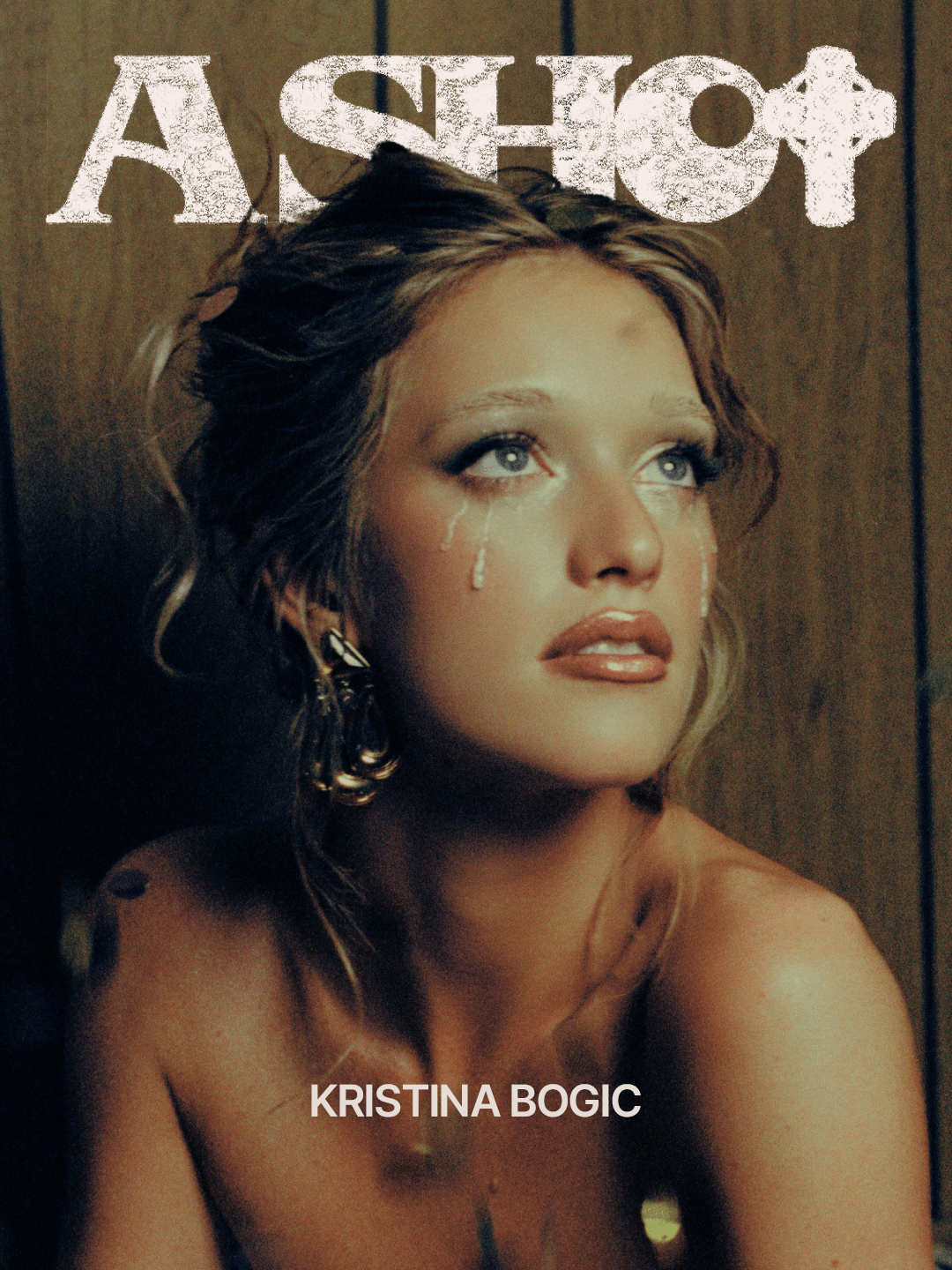
Anya has a lying problem. A pretty serious one, actually. She lies to her friends, she lies to herself, and whenever an opportunity presents itself to come clean, she somehow manages to make things worse. She’s also severely repressed, astonishingly bad at communicating her feelings, and has an unfortunate habit of making decisions that leave you yelling at your television. But Kristina? Kristina Bogic thinks she’s doing her best.
“I’m an Anya defender until I die,” the Australian actress tells A Shot, with the conviction of someone who has spent an extensive amount of time justifying the unjustifiable. And she has. While filming Netflix’s The Body, Kristina and her co-star Sara Boustany would regularly find themselves in their director, Quinn Shepard’s, office, passionately arguing their characters’ respective cases. Neither was interested in admitting her girl might be in the wrong. Kristina, especially, had made it her personal mission to understand Anya, even when Anya seemed determined to make that as difficult as possible.
It’s an interesting kind of loyalty to have for a character whose relationship with the truth is, at best, complicated, but it’s also what makes Kristina’s performance so compelling. Beneath Anya’s curated and maintained image as the dance team’s queen bee is a teenage girl struggling with desire, Catholic guilt, and a growing collection of secrets she has absolutely no idea what to do with. Where another actress might have leaned into the familiar mean-girl routine, Kristina went looking for something softer and more vulnerable.
That’s the thing about Anya. She’s not easy to forgive, but she’s surprisingly difficult to stop rooting for.
Getting the part, however, was less melodramatic than anything Anya gets up to on screen. Well, almost. When Kristina first came across the open casting call for The Body, it seemed like every young actress she knew was auditioning. She sent in a tape, as she had been doing for practically everything at the time, and then heard absolutely nothing. Naturally, the callback only materialized two months later—right on cue for maximum inconvenience: Kristina was halfway across Europe, travelling with her best friend—because nothing says 'method acting' like auditioning from a hostel.
Picture a dingy room, questionable Wi-Fi, people screaming downstairs, and an actress trying to cry convincingly on camera while her best friend lies in bed behind her. Not quite the glamorous Hollywood origin story one might imagine. Some way, somehow, amid the disarray, Kristina made it through five chemistry reads with Sara, who had already been cast as Elise. The connection, she remembers, was electric, buzzy, and instantaneous.
“I feel like we both just clicked. Like, we both just got it,” she says vehemently. Having someone to play opposite also helped her understand the show’s peculiar tone, which moves between teenage melodrama, psychological horror, and dark comedy without ever fully committing to just one. “If you get it, you get it. If you don’t, you don’t,” she adds about the show’s tone.
Rome, as it turned out, was the actual turning point. Days before the news broke, Kristina did the obligatory tourist thing: she stood at the Trevi Fountain, tossed a coin over her shoulder, and made a wish. Before she’d even left the city, her phone rang. She isn’t quite ready to credit divine intervention—though she’s not dismissing it, either. “I think everyone in the cast has some type of spiritual story about how they got the role,” she laughs. “So my wish is in the Trevi Fountain.”
Considering the show’s preoccupation with faith, guilt, and the supernatural, it’s a fitting beginning. Once she had the part, Kristina faced a different challenge: figuring out how to play a girl who, on paper, could easily have been another high-school mean girl. Anya is popular, a co-captain of the dance team, and accustomed to being in control. We’ve met versions of her many times before, usually terrorising the less popular girls in the cafeteria. Kristina had zero interest in playing a walking cliché.
“I just didn’t lean into any of the mean girl stereotypes with Anya,” Kristina explains. “I wanted Anya to lead with kindness, approaching the other girls with an almost maternal warmth.” She describes imagining her as “a little mother hen””, fiercely protective of her flock.
It was a conscious break from the roles she’d been auditioning for, and even playing, at the time. She had recently portrayed a character closer to the traditional mean-girl archetype and found herself frustrated by how little room those characters were given to exist beyond their cruelty. Too often, their worst behaviour was the entire personality.“I always ask myself, why are they mean? What had made them that way?” With Anya, she wanted to find the girl underneath the reputation.
Gallery 3 photos
Click a photo to view it full screenKristina had grown up watching Carrie, Mean Girls, and Jennifer’s Body, all films that helped establish the show’s strange marriage of girlhood and horror. She has a special affection for Jennifer’s Body, which she considers ahead of its time, especially in its embrace of camp.
Mid-way through filming, Kristina found a reference point in Céline Sciamma’s Portrait of a Lady on Fire, watching it on the strength of a tip that it had reduced director Quinn Shephard to tears. What stayed with her was the discipline of the acting: entire conversations happening in a held gaze, a hesitation, or a silence.
It was exactly the toolkit she needed for Anya, someone determined to keep her real emotions hidden from view. The goal, as Kristina saw it, was letting the audience see right through her, even when Anya couldn’t see through herself.After all, Anya can lie to practically everyone around her. Her face is another matter.
Unfortunately for Anya, keeping her feelings under lock and key is a full-time job. Between her position leading the dance team, her fraught dynamic with Elise, and the inconvenient matter of being a closeted Catholic teenager in 2004, she’s juggling plenty beneath the surface, and she has a remarkable talent for making every bit of it harder on herself.
Her relationship with Elise is especially volatile. There’s attraction, resentment, jealousy, and enough unresolved tension to keep the internet’s favourite fictional relationship analysts employed for months. The two girls understand each other better than anyone else, which, naturally, makes them exceptionally good at hurting each other. Anya, especially, knows exactly where to twist the knife.
For Kristina, the key to that tension lay in the subtle adjustments Anya makes depending on who’s watching. How she looks at Elise, how she holds herself around the other girls, even how she performs for Steven; it all points to someone perpetually caught between what she wants and what she believes she’s allowed to want. “I think sometimes you feel like your performance is judged by how much emotion you can pull out of yourself,” she explains, pointing to the pressure actors can feel to deliver an impressive crying scene.
She, however, found something more interesting in the moments when Anya was desperately trying to keep herself together, those moments where she’s white-knuckling her composure. Watching someone fight back tears is always more gripping than watching them fall, especially when it’s painfully obvious they’re about to lose. “Whenever you’re trying not to cry, it’s almost more heartbreaking to watch.”
It fits: Anya’s entire life is an exercise in keeping up appearances. Anya can be hysterical, defensive, and occasionally unreasonable, but beneath the outbursts is a girl who has spent so long suppressing her feelings that she barely knows what to do when they finally demand to be acknowledged.
And much of that suppression comes back to shame. Not only the shame surrounding her sexuality, but the discomfort of growing up in a body that seems subject to everyone else’s expectations. Kristina found herself connecting with Anya’s experience of guilt, particularly the way it intersects with bodily autonomy and the social pressures placed on young women. “I relate a lot to Anya regarding her shame around her own body and autonomy growing up,” she opens up.
It’s one of the reasons she believes the series has something meaningful to offer younger audiences. While Anya’s circumstances are particular to the show’s setting, the feelings underneath them are painfully familiar: wanting something you’re afraid to admit, worrying about how others perceive you, and trying to reconcile the person you are with the person you think you’re supposed to be.
Kristina admits that a character like Anya would have meant a great deal to her as a teenager. Not necessarily because Anya is someone to admire or imitate, but because there’s value in seeing a girl on screen who is allowed to be complicated, confused, and occasionally very, very wrong.
Of course, the internet has already developed a healthy appetite for exactly that kind of character. Even before the series reached audiences, Kristina had seen fan edits circulating online, with viewers dissecting the smallest interactions between Anya and Elise. A jealous glance, a loaded silence, an unfortunate choice of words: apparently, no detail is too small to become evidence in the court of TikTok.
Gallery 3 photos
Click a photo to view it full screenKristina knows exactly what some of those fans are here for. ““The fans like a bit of the toxicity. They always do,” she says, amused by the enthusiasm surrounding the girls’ relationship just from the trailer. She’s seen the edits, the speculation, and the excitement over Elise’s jealousy. Not at all surprised by any of it, she seems to understand the appeal. After all, she’s spent months defending one half of this extremely questionable romantic situation herself.
While Anya was busy having a full-blown existential crisis, Kristina had her own survival strategy for the long days on set. “Coffee, maybe a cheeky cigarette, maybe a cheeky couple of cigarettes, unfortunately,” she admits. Apparently, bringing a repressed, emotionally unraveling teenager to life requires a little caffeine and the occasional questionable coping mechanism.
Still, there’s something vulnerable about watching a project that once belonged to a small group of young actors become the subject of public fascination. During filming, the cast existed in their own little world, largely unaware of how audiences might eventually respond. Now, with the show finding its viewers, Kristina admits she feels protective of it, of the people who made it, and of Anya. Kristina goes to bat for Anya at every turn, though even she can’t defend all of her decision-making.
When asked whether she ever caught herself defending Anya while filming something objectively terrible, she doesn’t hesitate. “Literally every day.” She believes that judging a character too harshly can undermine a performance. If an actor doesn’t understand why their character behaves the way they do, the audience can feel that distance. Kristina then made it her job to justify Anya’s decisions, however questionable they became.
And she’s remarkably committed to the cause. Even when the conversation turns to whether Anya deserves forgiveness after everything she’s done, Kristina refuses to abandon her. She understands why some viewers might never forgive Anya, and she’s curious whether Grace ever could. But personally? She’s willing to let a few things slide. “I would forgive Anya,” she says. “I’d be like, girl, you’re going through it.” It’s certainly one way to describe it.
Gallery 3 photos
Click a photo to view it full screenKristina’s own teenage years, mercifully, looked nothing like Anya’s. There were no sinister visions, no elaborate cover-ups, and no imploding friendships to manage. Filming The Body handed her something she hadn’t quite had growing up: a proper high-school girl gang.
“I didn’t go to high school,” she tells us. “So I didn’t really get this teenage experience of girlhood and girlfriends.” Surrounded by a mostly young, mostly female cast for months, she ended up getting a belated version of the teenage camaraderie she’d missed out on. Eight weeks of gruelling dance rehearsals and marathon shoot days have a way of bonding people fast, and the cast quickly became inseparable off-screen.
“We really are a sisterhood,” she says, describing their bond as something almost sacred. Although she’s now on the other side of the world from many of her castmates, she feels she could call any of them if she needed somewhere to stay, someone to talk to, or simply a friend. It’s a sweet contrast to the friendships depicted on screen, where affection and loyalty have an unfortunate habit of getting tangled up with jealousy, suspicion, and the occasional betrayal. Off camera, the girls seem to have had a much easier time getting along.
Gallery 3 photos
Click a photo to view it full screenBehind the shoot
- Credit
- Photo Assistant - @ktdangershea
- Credit
- Handycam operator - alexpunch1
- Credit
- Art department - @ellikypriadis
- Credit
- Hair - @erinmbooher
- Credit
- Make up - @cultofkelby
- Credit
- Film developed by @arthousefilmlab
- Credit
- Special thanks to @x_gijoe + @surfacepr_